Bambu Lab Multi-Color 3D Printer Guide: Comparison & Selection
Selecting the right multi-material fabrication setup requires evaluating filament demands, chamber thermal control, automated calibration systems, and rapid spool switching.

What this report covers
- Models assessed
- 6
- Buyer rating range
- 4.0 – 4.8 of 5
- Last updated
- 25 Sep 2026
Figures above are read from the product listings for the models named below. Ratings are the average left by Amazon buyers, not a score awarded here.
As Amazon Associates, we earn from qualifying purchases. This means we may receive a small commission at no extra cost to you if you click through and make a purchase.
Selecting the right multi-material fabrication setup requires evaluating filament demands, chamber thermal control, automated calibration systems, and rapid spool switching. When shopping for a bambu lab multi color 3d printer, professionals must distinguish between open-frame systems optimized for rapid prototyping and fully enclosed platforms engineered to maintain consistent chamber temperatures for warp-prone polymers. Automated filament switching eliminates manual material changes, yet each configuration approaches spool drying, feed mechanics, and material limits with distinct technical trade-offs.
The Bambu Lab hardware ecosystem organizes its catalog around complete multi-material bundles, standalone base machines, dedicated drying and feeding modules, and surface interface adhesives. For teams deciding which bambu lab 3d printer to buy, the selection balances pre-packaged systems equipped with automated material units against standalone platforms that can be expanded later. Understanding how each bambu lab printer handles material handling and thermal stabilization is essential for building a reliable, high-uptime additive manufacturing workflow.
Criteria matrix What each model in this report is credited with
Rows are the criteria that come up in the pros and cons listed for this lineup. A check means the criterion is named in this report’s write-up of that model; a dash means it is not. Criteria that apply to every model, or to only one, are left out because they separate nothing.
| Criterion | Bambu Lab P1S Combo 4.6★ | Bambu Lab P2S Combo 4.0★ | Bambu Lab A1 Mini 4.1★ | High-Performance 3D Printer by 4.3★ | Bambu Lab P2S 3D 4.8★ | Bambu Lab Glue Stick 4.7★ |
|---|---|---|---|---|---|---|
| Enclosed | Named | Named | Named | Not named | Named | Named |
| Active | Named | Named | Named | Named | Named | Not named |
| Combo | Named | Named | Named | Named | Named | Not named |
| Engineering | Named | Named | Named | Named | Not named | Not named |
| PMSM servo extruder | Not named | Named | Not named | Not named | Named | Not named |
| Adaptive airflow | Not named | Named | Not named | Not named | Named | Not named |
| AI failure | Not named | Named | Not named | Not named | Named | Not named |
| Print bed | Not named | Not named | Named | Named | Not named | Not named |
| Criteria named | 4 / 8 | 7 / 8 | 5 / 8 | 4 / 8 | 6 / 8 | 1 / 8 |
Built from the wording of this report, not from a bench test. A dash is not a fault: it only means the write-up does not mention that point for that model. Star figures are the average rating left by Amazon buyers, read from the product listing.
Bambu Lab 3D Printers Lineup at a Glance
| Model | Form Factor & Enclosure | Speed & Motion System | Filament & Multi-Material Capabilities |
|---|---|---|---|
| Bambu Lab P1S Combo | Fully enclosed metal construction | 500 mm/s speed, 20,000 mm/s² acceleration | Up to 16 colors via AMS; ideal for PLA, PETG, ABS, ASA |
| Bambu Lab P2S Combo | Enclosed with Adaptive Airflow | Up to 600 mm/s, PMSM Servo Extruder | AMS 2 Pro with 65 °C spool drying; 50 °C chamber control |
| Bambu Lab A1 Mini Combo | Open-frame metal bed-slinger | 10,000 mm/s² acceleration | Multi-color with AMS lite; Active Flow Rate Compensation |
| High-Performance 3D Printer by Bambu Lab | Standalone feeder and drying module (AMS HT) | Brushless servo motor drive | Up to 24 colors; 85 °C high-temp drying, soft material bypass |
| Bambu Lab P2S 3D Printer | Enclosed base unit with carbon filter | Up to 600 mm/s, PMSM Servo Extruder | Single material out of box; requires combo upgrade for multi-color |
| Bambu Lab Glue Stick for 3D | 21 g surface adhesive stick | N/A (Bed preparation) | Compatible with PLA, ABS, PETG, PC, PA, TPU |
The Models in Detail
Bambu Lab P1S Combo

Best for: Enclosed multi-color engineering filament printing
Pros
- Up to 16 colors
- 500 mm/s print speed
- Fully enclosed metal body
- Automatic bed leveling
Cons
- Abrasive reinforced polymers not recommended
- Heavy 47.5 lb total weight
The Bambu Lab P1S Combo pairs an enclosed CoreXY machine with the automated material system, creating a versatile bambu lab 3d printer multi color workstation. The enclosed metal chassis provides structural rigidity and critical thermal containment, measuring 18.72 inches deep by 23.01 inches wide by 18.72 inches high and weighing 47.5 pounds. By stabilizing ambient internal air, the system reliably processes engineering filaments such as ABS and ASA alongside everyday PLA, PETG, TPU, PVA, and PET. The listing notes that while it is capable of extruding PA and PC, carbon fiber and glass fiber reinforced polymers are not recommended. Rapid production is powered by velocity benchmarks reaching 500 mm/s paired with 20,000 mm/s² acceleration.
Multi-color capabilities allow users to link up to 16 distinct colors or materials when connecting Bambu Lab AMS units. Setup is designed for rapid deployment, taking approximately 15 minutes to assemble and launch the automated bed leveling routine. This automatic bed leveling eliminates manual tramming, ensuring consistent first-layer squish directly from the initial configuration. The package operates in black metal styling, delivering high-speed execution without requiring extensive initial tuning.
This model is ideal for engineering teams and makers who require a bambu lab p1s combo to print functional prototypes in ABS, ASA, and standard plastics without stepping up to higher drying-tier hardware. It yields to the P2S platform when users require active chamber regulation, integrated 65 °C spool drying, or AI-driven defect management.
Bambu Lab P2S Combo
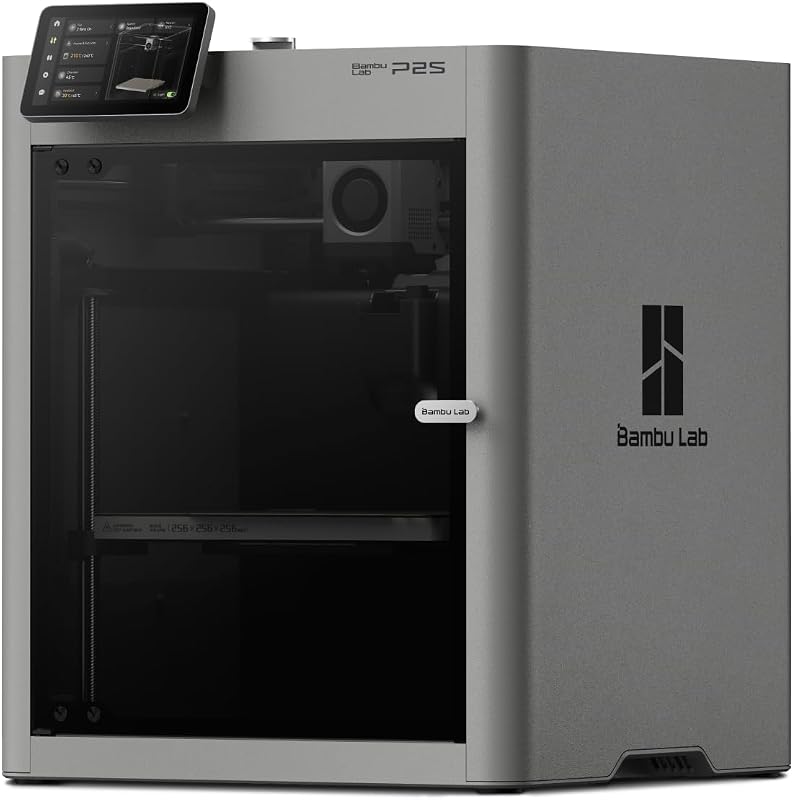
Best for: Single-material high-speed technical parts
Pros
- Up to 600 mm/s printing
- 50C engineering chamber control
- PMSM servo extruder
- AI failure detection
Cons
- No multi-color support out of box
- Requires AMS 2 Pro upgrade
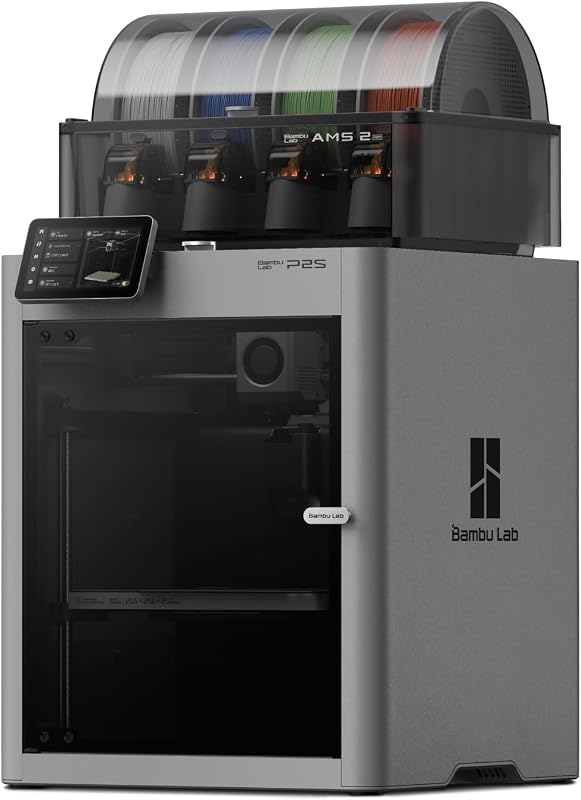
Best for: High-speed engineering builds with spool drying
Pros
- Up to 600 mm/s speed
- AMS 2 Pro with 65C drying
- Adaptive airflow 50C chamber
- AI failure detection
Cons
- Multi-color requires combo version
- Substantial desktop footprint
Representing an evolution in multi-spool automated production, the Bambu Lab P2S Combo integrates the P2S enclosed chassis with the advanced AMS 2 Pro module. Engineered for rapid mechanical movement, the printer reaches linear velocities up to 600 mm/s. Motion dynamics are driven by a permanent-magnet synchronous motor (PMSM) servo extruder paired with Active Flowrate Compensation, ensuring consistent line widths, smooth side walls, and sharp dimensional fidelity on complex corners. The listing specifies that the P2S base unit does not natively print multi-color alone; the combo version is required to unlock automated spool transitions.
A standout feature of the included AMS 2 Pro is built-in filament drying operating at temperatures up to 65 °C. Active drying protects moisture-sensitive polymers from hydrolysis during prolonged printing operations. Thermal conditions inside the build volume are managed by an Adaptive Airflow System, which alternates between directing cooling streams onto delicate bridges and retaining heat to hold a 50 °C internal chamber for technical thermoplastics. An integrated carbon filter purifies air output, while quick-swap nozzles, AI failure detection, and automatic calibration allow full deployment within 15 minutes of unpacking.
The system connects seamlessly with MakerWorld, Bambu Studio, and the Bambu Handy application on Windows 10 and smartphone environments. It suits professionals seeking the best bambu lab 3d printer for multi-color setups requiring actively heated filament storage and structural accuracy. It steps aside for the smaller A1 Mini when workstation real estate is constrained and technical chamber enclosures are unnecessary.
Bambu Lab A1 Mini Combo

Best for: Compact desktop multi-color rapid prototyping
Pros
- Full-auto calibration
- 10000 mm/s² acceleration
- 1-Clip quick swap nozzle
- Active flow rate compensation
Cons
- Open-frame design limits technical materials
- Requires AMS lite for multi-color
For compact spaces requiring automated material capabilities, the Bambu Lab A1 Mini Combo delivers reliable multi-spool printing within a reduced footprint. Featuring dimensions of 16.77 inches deep, 14.82 inches wide, and 19.5 inches high with a total mass of 10 kilograms, this silver metal machine pairs an accessible bed-slinger kinematic design with the external AMS lite module. Acceleration rates climb to 10,000 mm/s², making it an efficient platform for rapid visual prototyping, product testing, and color-coded design iterations.
The A1 Mini eliminates calibration friction through a comprehensive full-auto calibration sequence. The system handles Z-offset adjustment, bed-leveling routines, and vibration compensation without manual operator intervention. High-precision extrusion is maintained through an Active Flow Rate Compensation algorithm that continuously calculates and adjusts polymer output. Assembly takes 20 minutes from box to print bed thanks to pre-assembled core modules, and routine maintenance is streamlined by a 1-Clip quick-swap nozzle assembly.
Controlled via a simplified touchscreen interface, the unit works cleanly with non-enclosure materials such as bambu filament pla and PETG. This bambu lab a1 mini combo is best suited for schools, design studios, and desktop workstations that prioritize quiet operation and small footprints over enclosed chamber heat retention. It yields to the P1S or P2S combos when users must print high-temperature, warp-susceptible engineering materials like ABS or PC.
High-Performance 3D Printer by Bambu Lab
Best for: Industrial high-temperature filament drying and routing
Pros
- Up to 24 colors capacity
- 85C active air vent drying
- Brushless servo motor
- Bypass for soft or brittle materials
Cons
- Requires laptop or PC connection
- Dedicated module without print bed
The High-Performance 3D Printer by Bambu Lab listing presents the AMS HT, an industrial-grade external multi-material and drying unit. Built using a durable PC/PA composite structure weighing 1.21 kilograms, this specialized hardware handles multi-material routing for up to 24 colors across connected systems. It solves a primary challenge in advanced additive manufacturing: keeping engineering filaments thoroughly desiccated while feeding them smoothly through complex multi-spool workflows.
The unit features an active 85 °C high-temperature drying environment governed by electromagnetic air vent technology. An internal rotating mechanism drives automatic drying cycles, circulating hot air to strip deep moisture from hygroscopic materials before they enter the toolhead. Smooth mechanical feeding is powered by an integrated brushless servo motor, while an independent bypass outlet accommodates brittle filaments or soft elastic polymers that struggle in conventional multi-material feed paths. Integrated RFID sensors synchronize automatically with official Bambu filaments to load precise drying profiles.
Accepting STL and OBJ file formats via laptop or personal computer links, this hardware serves industrial labs and production floors managing advanced polymer conditioning. It is not an all-in-one printer on its own; rather, it functions as an advanced filament management hub. For users seeking a ready-to-run machine straight out of the box, integrated solutions like the P1S Combo or P2S Combo remain the primary choice.
Bambu Lab P2S 3D Printer
The standalone Bambu Lab P2S 3D Printer delivers the core mechanical and thermal architecture of Bambu Lab’s updated enclosed series without bundling an automated material switcher. With dimensions of 18 inches deep by 21 inches wide by 18 inches high and a weight of 38.9 pounds, this grey enclosed system features the same high-velocity kinematics as its combo sibling, operating at speeds up to 600 mm/s. Extrusion reliability is driven by the PMSM Servo Extruder, which pairs with Active Flowrate Compensation to maintain structural corners and uniform surface textures.
The listing makes an important distinction for shoppers: the base P2S 3D printer does not support multi-color printing on its own, explicitly requiring the Combo version or an added feeder unit to execute multi-material files. However, it incorporates all advanced standalone enclosure mechanics, including an Adaptive Airflow System with an internal carbon filter capable of maintaining a 50 °C chamber environment for advanced single-spool industrial thermoplastics. Machine readiness takes 15 minutes, supported by automated calibration routines, quick-swap nozzle assemblies, and onboard AI failure detection.
This bambu lab p2s 3d printer serves production facilities and technical specialists who require an enclosed, high-speed machine for dedicated single-material functional prints. It gives way directly to the P2S Combo when multi-color versatility, multi-spool redundancy, or active 65 °C filament drying is required from day one.
Bambu Lab Glue Stick for 3D
Best for: First layer adhesion across all models
Pros
- Formaldehyde-free formula
- Supports standard and technical filaments
- Protects build plate surface
Cons
- Single 21g stick pack
- Manual application required
The Bambu Lab Glue Stick for 3D printer build plates is a dedicated bed adhesive designed to optimize build plate grip and facilitate clean part detachment. Supplied as a single 21 g white stick, this adhesive provides a reliable bonding layer across build surfaces. Applying a thin, even coat helps resolve first-layer lifting, edge peeling, and corner distortion on difficult geometries.
Safety and broad utility are central to its chemical design. The formula is completely formaldehyde-free, making it suitable for unventilated spaces, home offices, and educational classrooms. The listing specifies wide filament compatibility across PLA, ABS, PETG, PC, PA, and TPU. In addition to securing parts during high-acceleration prints, the layer acts as an interface barrier that prevents aggressive polymers like PETG and TPU from damaging build surfaces upon cooling. Exploring dedicated bed prep options in a bambu labs glue comparison highlights how uniform bed coatings minimize print scrap rates.
This adhesive is compatible with all Bambu Lab series printers, making it an essential baseline accessory regardless of whether an operator uses an open-frame A1 Mini or an enclosed P-series machine. It gives way to bare textured plates only when working exclusively with standard PLA that requires no secondary adhesion assist.
Matching a Model to Your Setup
- High-Temperature Engineering & Multi-Color Production: Choose the Bambu Lab P2S Combo for its 600 mm/s speed, 50 °C chamber temperature retention, and AMS 2 Pro featuring active 65 °C filament drying.
- Enclosed Multi-Material Prototyping on Standard Budgets: Select the Bambu Lab P1S Combo to access up to 16 colors and enclosed ABS/ASA printing at 500 mm/s speeds without needing active spool drying.
- Compact Desktops & Visual Multicolor Prints: Deploy the Bambu Lab A1 Mini Combo for rapid PLA/PETG iteration with AMS lite, automatic calibration, and a space-saving footprint.
- Single-Material Technical Printing with Chamber Control: Invest in the Bambu Lab P2S 3D Printer to print rigid engineering plastics inside a 50 °C heated chamber with AI failure mitigation before adding multi-color units later.
- Industrial Desiccation for Hygroscopic & Brittle Filaments: Integrate the High-Performance 3D Printer by Bambu Lab (AMS HT) to handle 85 °C high-temp drying, up to 24 colors, and specialized bypass feeding for soft materials.
- First-Layer Reliability Across Any Bambu Machine: Stock the Bambu Lab Glue Stick for 3D to ensure consistent bed adhesion and surface protection across PLA, ABS, PETG, TPU, PC, and PA.
Before You Buy
Before purchasing hardware from this lineup, review physical space requirements and filament routing specifications. The enclosed P1S and P2S units carry physical weights ranging between 38.9 and 47.5 pounds, requiring stable, vibration-resistant workbenches capable of absorbing high-acceleration forces. While combo packages include the necessary multi-material units, the listings do not specify secondary consumable accessories such as replacement PTFE tubing, spare cutter blades, or specialized cleaning brushes. Reviewing broader bambu lab accessories helps ensure all supplemental workshop tooling is secured ahead of initial production.
Filament limitations also demand careful planning based strictly on listing disclosures. The Bambu Lab P1S Combo explicitly notes that carbon fiber and glass fiber reinforced polymers are not recommended, meaning users requiring abrasive composites must budget for hardened component upgrades. Furthermore, the standalone P2S 3D printer listing emphasizes that it cannot execute multi-color prints without acquiring a combo bundle or separate feeder unit. Finally, units like the AMS HT serve drying and multi-color feeding functions for external hosts but require compatible PC or laptop controllers to manage STL and OBJ workflows.
FAQ
Can the standalone Bambu Lab P2S 3D Printer print multi-color out of the box?
No. The listing explicitly states that the P2S 3D printer does not support multi-color printing on its own. To achieve multi-color or multi-material capabilities, the Combo version featuring the AMS 2 Pro is required.
How many colors can the Bambu Lab P1S Combo support?
The Bambu Lab P1S Combo can support up to 16 colors or materials. Connecting Bambu Lab AMS units is required to access the full 16-color capacity.
What drying capabilities does the Bambu Lab P2S Combo offer?
The P2S Combo includes the AMS 2 Pro, which features built-in filament drying operating at temperatures up to 65 °C to keep spools conditioned for printing. It also incorporates an Adaptive Airflow System that maintains a 50 °C chamber temperature for engineering materials.
What materials can be printed on the Bambu Lab P1S Combo?
According to its listing, the P1S Combo is ideal for PLA, PETG, TPU, PVA, PET, ABS, and ASA. It is capable of processing PA and PC, but carbon fiber and glass fiber reinforced polymers are not recommended.
What is the difference between the AMS lite and AMS 2 Pro?
The AMS lite, bundled with the Bambu Lab A1 Mini Combo, is an exposed multi-spool feeder designed for open-frame desktop multi-color printing. In contrast, the AMS 2 Pro bundled with the P2S Combo includes an enclosed design with active spool drying up to 65 °C.
Is the Bambu Lab Glue Stick safe for regular indoor use?
Yes. The Bambu Lab Glue Stick is manufactured with a formaldehyde-free formula, making it a safer option for indoor workspaces while providing adhesion across PLA, ABS, PETG, PC, PA, and TPU filaments.


