Ecovacs Window Cleaner Robot Lineup: Which Model Should You Choose?
Selecting an ecovac window cleaner robot requires evaluating your architectural glass, available power sources, and the degree of manual maintenance you want to eliminate.

What this report covers
- Models assessed
- 6
- Our score range
- 8.0 – 8.6/10
- Last updated
- 25 Sep 2026
Figures above are read from the product listings for the models named below. Scores are out of 10, based on listed specifications and buyer feedback.
As Amazon Associates, we earn from qualifying purchases. This means we may receive a small commission at no extra cost to you if you click through and make a purchase.
Selecting an ecovac window cleaner robot requires evaluating your architectural glass, available power sources, and the degree of manual maintenance you want to eliminate. Homeowners and office managers typically choose between compact handheld units engineered for tight casements and comprehensive station-backed platforms that provide independent battery operation. Much like deciding between basic cleaning tools and an autonomous roomba vacuum cleaner for indoor floors, choosing a glass-cleaning robot centers on how much automation your space demands. Getting the right machine prevents issues like persistent edge streaks, tether tangles, and inadequate suction on expansive vertical glass.
The Ecovacs catalog separates into three clear hardware tiers based on station integration, motor output, and form factor. At the portable end, standalone compact units focus on lightweight handling and maneuverability across small window frames, glass doors, and bathroom mirrors. The mid-tier incorporates the multi-functional OMNI station, adding onboard battery power packs and cable management that eliminate the need for an adjacent wall outlet. At the high end of this ecovac window cleaner robot comparison, advanced units feature automated pad washing, intelligent edge scrubbers spinning at high speed, and suction levels reaching 10,000Pa. Understanding which ecovacs window cleaner to buy comes down to matching these specific station capabilities, navigation algorithms, and chassis dimensions to your glass layouts.
Criteria matrix What each model in this report is credited with
Rows are the criteria that come up in the pros and cons listed for this lineup. A check means the criterion is named in this report’s write-up of that model; a dash means it is not. Criteria that apply to every model, or to only one, are left out because they separate nothing.
| Criterion | WINBOT MINI 2 Compact 8.2/10 | WINBOT W2 PRO Omni 8.2/10 | WINBOT W3 Omni Robot 8.0/10 | WINBOT W2S Omni Window 8.6/10 | ECOVACS | WINBOT W2S PRO Window 8.4/10 |
|---|---|---|---|---|---|---|
| Power | Named | Named | Not named | Named | Named | Named |
| WIN-SLAM | Named | Named | Named | Not named | Not named | Named |
| Suction | Named | Not named | Not named | Named | Named | Named |
| OMNI station | Not named | Not named | Not named | Named | Named | Named |
| Battery operation | Not named | Named | Not named | Named | Not named | Not named |
| Corded electric | Not named | Not named | Not named | Named | Not named | Named |
| Pad washing | Named | Named | Not named | Not named | Not named | Not named |
| RPM TruEdge | Not named | Not named | Named | Named | Not named | Not named |
| Criteria named | 4 / 8 | 4 / 8 | 2 / 8 | 6 / 8 | 3 / 8 | 5 / 8 |
Built from the wording of this report, not from a bench test. A dash is not a fault: it only means the write-up does not mention that point for that model. Scores next to each model are out of 10, based on listed specifications and buyer feedback.
Ecovacs Window Cleaner Robots Lineup at a Glance
Best for: Entry-level daily apartment window touchups
Pros
- Compact 8.46-inch profile
- Dual ultrasonic mist spray
- Low-noise operation profile
Cons
- Unspecified battery operating life
- Limited to three cleaning modes
| Model | Form Factor | Suction & Safety | Power & Battery | Navigation & Spray |
|---|---|---|---|---|
| ECOVACS WINBOT MINI 2 Compact Window | Rectangular (8.46 x 8.46 x 2.17 in) | 8,000Pa suction; 10-tier protection | 200 min battery; 110V; 30+ min power drop backup | WIN-SLAM 4.0; Ultrasonic atomization (10 micron) |
| ECOVACS WINBOT W2 PRO Omni Portable | Robotic with 6-in-1 OMNI Station | 12-stage protection; Anti-fall system | Dual mode: Battery (110 min) or Plugged-in; 110V | WIN-SLAM 4.0; 3-nozzle wide-angle spray |
| ECOVACS WINBOT W3 Omni Robot Window | Round with Self-Cleaning Station | 12-level protection; TruEdge 200 RPM scrubber | 130 min battery; Battery powered; 1.1L capacity | WIN-SLAM 5.0; Triple-nozzle wide-angle spray |
| ECOVACS WINBOT W2S Omni Window Cleaning | Rectangular with 6-in-1 OMNI Station | 8,000Pa suction; 12-level safety system | Dual mode: Battery (110 min) or AC; 110V | WIN-SLAM 4.0; Triple wide-angle spray |
| ECOVACS | Compact (8.46 x 8.46 x 2.17 in) | 9-stage protection system | Lithium Ion; Runtime not specified | Intelligent path planning; Dual ultrasonic nozzles |
| ECOVACS WINBOT W2S PRO Window Cleaning | Round chassis | 10,000Pa suction; 10-stage safety (6 hardware) | Corded electric; 30 min safety backup battery | WIN-SLAM 4.0; Triple-spray wet wiping |
The Models in Detail
ECOVACS WINBOT MINI 2 Compact Window

Best for: Narrow panes and interior mirrors
Pros
- 8,000Pa suction grip
- Sub-1mm edge cleaning pass
- Compact 8.46-inch frame
Cons
- 60-microliter listed reservoir
- Designed for light maintenance
The ECOVACS WINBOT MINI 2 Compact Window provides an ultra-compact solution tailored for narrow glass sections, frameless railings, and interior mirrors. Measuring 8.46 by 8.46 by 2.17 inches, its rectangular profile navigates tighter clearances than full-sized robotic cleaners, operating on glass panels with dimensions down to the minimum applicable window size specified as 8 inches. Its edge-cleaning mechanism combines four high-density corner brushes that rotate against frames with side wings that guide the microfiber pad within 1 millimeter of borders, yielding up to 90 percent edge coverage. Ultrasonic atomization generates 10-micron mist droplets to dissolve fingerprints and light airborne residue while preventing excessive moisture accumulation.
Holding power relies on an 8,000Pa suction motor backed by an active air-pressure compensation system and a 10-tier safety architecture. If electrical supply cuts unexpectedly, internal battery backup keeps the chassis suctioned to the pane for over 30 minutes, supported by an included safety tether. Cleaning routes are coordinated by WIN-SLAM 4.0 navigation across five dedicated settings: Fast, Thorough, Deep, Spot, and Edge Clean. The listing documents a battery life of 200 minutes, a 60-microliter fluid capacity, a washable filter, and app management over Bluetooth. This model is ideal for residential apartments, small office partitions, and routine dust maintenance, though heavily caked dirt requires running multiple cycles or laundering the pad.
Compared to station-tethered alternatives in this ecovacs winbot comparison, the Mini 2 prioritizes minimal storage footprint over automated station conveniences. It lacks an independent cleaning base, which means operators handle water refills and pad washing manually between cycles. It suits buyers seeking an agile, easily stored maintenance tool for standard glass, handing over to the larger OMNI series when expansive glass expanses or outlet-free outdoor balconies are the priority.
ECOVACS WINBOT W2 PRO Omni Portable
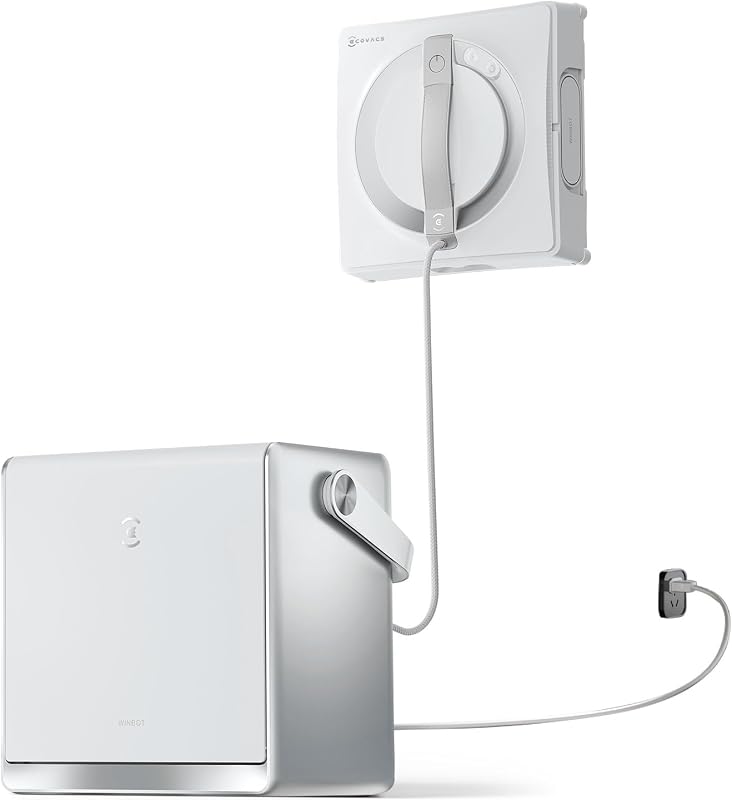
Best for: Windows lacking nearby wall electrical outlets
Pros
- Dual battery and cord modes
- 6-in-1 portable station
- 110-minute battery operation
Cons
- Substantial station footprint
- Manual pad washing required
The ECOVACS WINBOT W2 PRO Omni Portable shifts the cleaning workflow by introducing a portable 6-in-1 multi-functional station. This base acts as an onboard command center, internal lithium-ion power bank, stabilizer weight, and integrated storage container for the robot and cables. The inclusion of dual power modes allows the robot to run cord-free from wall outlets on battery power for up to 110 minutes, covering roughly 55 square meters on a single charge, or operate indefinitely when connected directly to standard 110-volt AC power. This versatility makes it practical for balconies, exterior balustrades, and high transoms where power outlets are out of reach.
Wiping efficacy is driven by a wide-angle triple-nozzle spray array paired with an upgraded brushless motor that delivers a 100 percent increase in water pressure and a 90 percent improvement in operating spray consistency. Guided by WIN-SLAM 4.0 path planning, the robot increases navigation efficiency by 30 percent, optimizing turn patterns along borders to avoid missed tracks. Safety is anchored by a 12-stage hardware and software protection suite, an anti-fall system, five selectable power levels, and manufacturer-backed insurance protection against glass dislodgement during operation.
This model is built specifically for users managing extensive exterior glass, sliding patio doors, or tall windows lacking nearby electrical infrastructure. While the unit provides automated cleaning paths, the operator must still detach and wash the cleaning pad manually after use. It gives way to the W3 Omni if you require fully automated pad cleaning without handling dirty microfiber textiles.
ECOVACS WINBOT W3 Omni Robot Window

Best for: Hands-free automated pad maintenance
Pros
- 16-nozzle Vortex wash station
- WIN-SLAM 5.0 obstacle avoidance
- Active 200 RPM TruEdge scrubber
Cons
- Large base station setup
- Round chassis edge geometry
The ECOVACS WINBOT W3 Omni Robot Window delivers the highest level of station autonomy in the lineup by integrating an active mop washing dock. The Vortex Wash system inside the station utilizes 16 high-pressure nozzles to scrub the robot’s cleaning pad clean in approximately 1 minute, paired with an optional station self-cleaning cycle that flushes out lingering grime. A substantial 1.1-liter fluid capacity supports extensive cleaning routines without constant refilling. For busy homeowners who want an automatic window cleaning robot ecovacs platform that handles routine maintenance without dirtying hands, this self-cleaning dock changes the maintenance routine entirely.
Glass contact and scrubbing utilize proprietary TruEdge technology, deploying an edge scrubber that mechanically lowers when approaching frames, spinning at 200 RPM into corners to strip hardened dirt in a single pass. The scrubber retracts automatically during transit to prevent cross-contaminating clean glass. Navigation utilizes WIN-SLAM 5.0, achieving dynamic obstacle avoidance with 1-millimeter precision across Fast, Intensive, and Zone modes. A triple-nozzle wide-angle spray system ensures complete hydration across the surface, backed by a 130-minute battery runtime and a 12-level safety protection design.
Much like maintaining automated floor care with dedicated chemicals like roborock official floor cleaning solution, operating a high-end window station requires understanding its operational fluids and space footprint. The W3 Omni demands dedicated floor space for its self-washing base station. It is the premier choice for multi-story residences with floor-to-ceiling glass expanses, handing off to simpler models if your home only has small, divided window panes that do not warrant an automated washing dock.
ECOVACS WINBOT W2S Omni Window Cleaning
Best for: Large glass panes needing maximum hold
Pros
- 10,000Pa vacuum suction
- TrueEdge 2.0 perimeter brushes
- 1-fluid-ounce fluid tank
Cons
- Requires constant corded electric power
- 30-minute backup battery only

Best for: Framed windows requiring aggressive corner scrubbing
Pros
- 200 RPM TruEdge corner scrubbing
- Quad-edge frame detection
- Cordless and plug-in operation
Cons
- 80-microliter listed capacity
- Heavier portable OMNI station
The ECOVACS WINBOT W2S Omni Window Cleaning robot pairs high-intensity mechanical edge agitation with the portable convenience of the 6-in-1 OMNI Station. Its primary distinction is TruEdge scrubbing integration on a rectangular chassis, deploying a peripheral mechanical scrubber that drops down along window frames and rotates at 200 RPM to strip hardened grime from sills and corners. Advanced quad-edge detection scans all four window borders, ensuring the robot maintains steady contact along frames, frameless balustrades, and even tilted architectural glass panels.
The fluid delivery system uses three wide-angle spray nozzles supplied by an onboard reservoir designed to loosen pollen, fingerprints, and settled dust. The listing notes an 80 mL water tank capacity in its text alongside an 80-microliter spec entry, paired with an 8,000Pa suction motor and intelligent anti-slip climbing treads for traction. Like other OMNI-station products, it supports dual power modes: cordless battery operation delivering up to 110 minutes of run time, or continuous AC power for whole-house cleaning marathons, all shielded by a 12-level safety framework.
This model suits homeowners whose primary frustration with robotic window cleaners is residual dirt ribbons left along borders and frame gaskets. Similar to how a hybrid eufy vacuum and mop balances vacuum suction with scrubbing friction, the W2S Omni uses its active 200 RPM brush to eliminate edge residue. It yields to the W3 Omni if you need the station itself to wash the wiping pads automatically after completing the glass.
ECOVACS
The 2026 version of the compact platform, listed plainly as ECOVACS WINBOT Mini, delivers streamlined, essential glass cleaning tailored for smaller living spaces and apartments. Constructed with dimensions of 8.46 by 8.46 by 2.17 inches in a clean white chassis, it emphasizes quick setup and zero learning curve. Users attach the robot to glass, power up the suction motor, and let the system begin cleaning without configuring complicated docking hubs or balancing peripheral weights. Its lightweight form factor is particularly well-suited for single-hung windows, decorative glass cabinetry, and tiled bathroom partitions.
Surface cleaning utilizes dual spray nozzles featuring ultrasonic atomization, delivering a fine mist that loosens daily fingerprints, airborne film, and light smudges without over-saturating the glass. Movement is directed by intelligent path planning across three dedicated cleaning modes, supported by a 9-stage protection system to maintain attachment stability. The motor assembly is engineered for low-noise operation, allowing it to clean interior panes while occupants work or relax nearby without distracting acoustic intrusion. The unit includes a washable filter and an integrated lithium-ion battery system.
This straightforward unit is the ideal starting point for first-time buyers seeking routine maintenance on small to mid-sized interior windows. Unlike the heavy-duty commercial-grade units, the listing does not specify a numerical suction rating or exact battery run time, emphasizing light routine care over heavy restoration. If your property features massive exterior glass panes covered in dried storm residue, stepping up to the corded W2S PRO or an OMNI station model is recommended.
ECOVACS WINBOT W2S PRO Window Cleaning
The ECOVACS WINBOT W2S PRO Window Cleaning robot represents maximum raw pneumatic power in the lineup, generating an industry-leading 10,000Pa suction grip. Unlike the battery-first OMNI station variants, this machine operates via corded electric power, ensuring sustained, unyielding suction for extensive cleaning projects. Its 10-stage safety framework divides into six physical hardware fall-prevention measures and three intelligent monitoring safeguards, giving operators complete confidence when running the machine on towering floor-to-ceiling windows and high commercial glass.
Edge coverage utilizes TrueEdge 2.0 technology, combining four edge brushes and dense felt bristles that sweep along window frames to leave minimal perimeter margins. Fluid application is powered by a triple-spray wet wiping array fed by a 4.1-fluid-ounce onboard reservoir, evenly applying fluid to loosen environmental grime, bird marks, pollen, and hard water spots. Navigation is directed by WIN-SLAM 4.0, offering six distinct operational programs: Fast, Thorough, Edge, Heavy-Duty, Deep, and Zone cleaning. The internal lithium-ion battery provides 30 minutes of emergency holding power in the event of an electrical failure.
This model is built specifically for users with large, challenging architectural windows who prioritize vacuum grip and continuous operation over battery portability. Because it operates via corded electric power, it eliminates the battery-depletion constraints of portable stations. It gives way to the W2 PRO or W2S Omni when cleaning remote panes that lack a nearby wall outlet.
Matching a Model to Your Setup
- Apartments and townhomes with compact panes: The ECOVACS WINBOT MINI 2 Compact Window is best for tight casements, mirrors, and glass doors due to its 8.46-inch profile and sub-1mm edge clearance.
- Balconies and terraces without outdoor electrical outlets: The ECOVACS WINBOT W2 PRO Omni Portable excels here with its 6-in-1 OMNI station offering 110 minutes of cordless battery operation.
- High-end homes demanding zero manual pad washing: The ECOVACS WINBOT W3 Omni Robot Window suits large installations where the 16-nozzle Vortex Wash station automatically cleans pads after every run.
- Framed glass with stubborn perimeter dirt build-up: The ECOVACS WINBOT W2S Omni Window Cleaning model provides active frame cleaning with its 200 RPM motorized TruEdge scrubber.
- First-time users wanting quick daily touch-ups: The compact ECOVACS WINBOT Mini offers simple, low-noise operation for light indoor fingerprint and dust removal without station clutter.
- Towering floor-to-ceiling exterior windows: The ECOVACS WINBOT W2S PRO Window Cleaning robot provides unmatched security with 10,000Pa suction and corded continuous runtime.
Before You Buy
While automated window cleaning robots significantly reduce manual glass maintenance, buyers must understand the physical realities of vertical robotic cleaning before purchasing. Ecovacs machines are optimized for maintenance washing rather than heavy post-construction detailing. Glass caked in thick mud, heavy mineral scaling, or baked-on tree sap typically requires an initial manual wipe-down or targeted pre-treatment with a specialized product such as rainx window cleaner before deploying a robot. Running a microfiber pad over heavy abrasive grit without pre-cleaning can scratch coatings or cause the drive treads to slip. Operators should also note discrepancies in listing capacity data, where fluid metrics vary between microliter and milliliter listings depending on the model tier.
Operational setups also vary widely between corded electric platforms and OMNI station variants. Corded models like the W2S PRO require a clear, unobstructed path to an indoor wall outlet and use their internal lithium-ion batteries solely as emergency fall-prevention backups, lasting approximately 30 minutes during power cuts. Conversely, battery-equipped OMNI stations provide portable flexibility but add significant weight and bulk that must be transported between cleaning zones. Furthermore, while these robots function on framed, frameless, and slightly tilted flat glass, the listings do not specify functionality on curved architectural glass, severely textured panes, or horizontal skylights.
FAQ
What is the best ecovacs window cleaner robot for edge cleaning?
The ECOVACS WINBOT W2S Omni Window Cleaning and ECOVACS WINBOT W3 Omni Robot Window offer the best edge cleaning performance due to their active TruEdge motorized scrubbers. These units mechanically lower an auxiliary scrubbing module along the frame that spins at up to 200 RPM to strip away dirt lines. For compact spaces, the ECOVACS WINBOT MINI 2 Compact Window also provides exceptional edge reach, utilizing rotating corner brushes and ultra-thin guide wings that bring the microfiber pad within 1 millimeter of the window border for up to 90 percent edge coverage.
Can an automatic window cleaning robot ecovacs model clean frameless glass safely?
Yes, Ecovacs models including the MINI 2, W2S Omni, and W2S PRO feature intelligent edge-detection sensors that identify air boundaries on frameless glass railings, shower screens, and mirrors. When the robot approaches an edge where air pressure drops, the navigation system instantly reverses trajectory to prevent overshooting the pane, while internal fall-protection hardware keeps the vacuum suction steady.
How do battery-powered OMNI stations differ from corded Winbot models?
The primary difference lies in mobility versus continuous operational stamina. OMNI station models, such as the W2 PRO and W2S Omni, house a substantial internal battery providing up to 110 minutes of cordless operation, allowing you to clean remote outdoor glass and balconies without running extension cords. Corded electric units, such as the W2S PRO, must stay plugged into a wall outlet during cleaning, using their internal battery strictly as an emergency 30-minute backup if power fails, but they deliver higher continuous suction reaching 10,000Pa.
Do Ecovacs window cleaner robots wash their own cleaning pads?
Among the models compared, only the ECOVACS WINBOT W3 Omni Robot Window features an automated self-cleaning station. Its Vortex Wash dock utilizes 16 high-pressure spray nozzles to wash and flush the wiping pad in just 1 minute without manual intervention. All other models in the lineup require the user to detach the microfiber pad, rinse or machine-wash it, and reattach it between cleaning cycles.
Which ecovacs window cleaner to buy for small apartment windows?
For apartments, condominiums, or homes with smaller multi-pane windows, the ECOVACS WINBOT MINI 2 Compact Window or the baseline ECOVACS Mini are the best choices. Their 8.46-inch square profiles allow them to maneuver within tight frames where larger OMNI-station robots cannot fit, while their compact weight makes them easy to store in standard cabinetry without dedicating floor space to a large dock.


