Google Whole Home Wi-Fi: Nest Pro vs. Standard Mesh Compared
Establishing a dependable google whole home network requires balancing device density, internal home architecture, and wireless bandwidth capacity.

What this report covers
- Models assessed
- 6
- Our score range
- 8.4 – 9.8/10
- Last updated
- 11 Oct 2026
Figures above are read from the product listings for the models named below. Scores are out of 10, based on listed specifications and buyer feedback.
As Amazon Associates, we earn from qualifying purchases. This means we may receive a small commission at no extra cost to you if you click through and make a purchase.
Establishing a dependable google whole home network requires balancing device density, internal home architecture, and wireless bandwidth capacity. Busy professionals evaluating mesh networking hardware often confront confusing model designations that obscure critical technical distinctions between operating frequencies and transmission protocols. Selecting an appropriate google whole home wifi deployment means identifying whether your residential environment demands modern tri-band Wi-Fi 6E connectivity for latency-sensitive tasks or if standard dual-band Wi-Fi 5 routing provides adequate throughput for daily streaming, web navigation, and routine remote office applications. Making an informed choice prevents network bottlenecks while ensuring your physical property receives consistent signal coverage without wasteful hardware redundancy.
The current manufacturer portfolio is segmented into two primary generations: the established Wi-Fi 5 (802.11ac) Google Wifi family and the advanced Wi-Fi 6E (802.11ax) Nest Wifi Pro system. A pivotal boundary exists across these product lines, as Nest Wifi Pro nodes incorporate a dedicated 6 GHz radio band and operate independently from legacy hardware, lacking backward mesh compatibility with earlier generations. Within this catalog, models are further distinguished by packaging configurations, multipack hardware node counts, and certified renewed designations that determine overall coverage footprints ranging from 1,500 square feet to 6,600 square feet. Understanding how these listings differ in hardware capabilities and network roles allows you to pinpoint the exact setup required for your property.
Criteria matrix What each model in this report is credited with
Rows are the criteria that come up in the pros and cons listed for this lineup. A check means the criterion is named in this report’s write-up of that model; a dash means it is not. Criteria that apply to every model, or to only one, are left out because they separate nothing.
| Criterion | Nest WiFi Pro 8.4/10 | WiFi System 9.0/10 | Nest WiFi Pro (3) 9.2/10 | WiFi Mesh Router System 8.6/10 | Nest WiFi Pro 6E 9.2/10 | Nest WiFi Pro (6) 9.8/10 |
|---|---|---|---|---|---|---|
| Coverage | Named | Named | Not named | Named | Named | Named |
| Wireless | Named | Named | Named | Named | Named | Not named |
| Network | Named | Named | Not named | Named | Named | Named |
| Compatibility | Named | Named | Not named | Named | Named | Not named |
| Data transfer rate | Named | Not named | Not named | Not named | Named | Named |
| Google mesh | Named | Not named | Named | Not named | Not named | Named |
| Google Wifi points | Named | Not named | Not named | Named | Not named | Not named |
| Bandwidth rated | Named | Not named | Named | Not named | Not named | Not named |
| Criteria named | 8 / 8 | 4 / 8 | 3 / 8 | 5 / 8 | 5 / 8 | 4 / 8 |
Built from the wording of this report, not from a bench test. A dash is not a fault: it only means the write-up does not mention that point for that model. Scores next to each model are out of 10, based on listed specifications and buyer feedback.
Google Mesh Wi-Fi Systems Lineup at a Glance
| Model | Wi-Fi Standard | Frequency Bands | Coverage Footprint | Port Count |
|---|---|---|---|---|
| Google Nest WiFi Pro (3-Pack, Non-Retail) | Wi-Fi 6E (802.11ax) | Tri-Band (2.4, 5, 6 GHz) | Up to 6,600 sq. ft. | 4 Ports |
| Google WiFi System (1-Pack) | Wi-Fi 5 (802.11ac) | Dual-Band (2.4, 5 GHz) | Up to 1,500 sq. ft. | 3 Ports |
| Google Nest WiFi Pro (3-Pack, Retail) | Wi-Fi 6E (802.11ax) | Tri-Band (2.4, 5, 6 GHz) | Up to 6,600 sq. ft. | 4 Ports |
| Google WiFi Mesh Router System (2-Pack) | Wi-Fi 5 (802.11ac) | Dual-Band (2.4, 5 GHz) | Up to 3,800 sq. ft. | Unspecified in listing |
| Google Nest WiFi Pro 6E GA03030-US (1-Pack) | Wi-Fi 6E (802.11ax) | Tri-Band (2.4, 5, 6 GHz) | Up to 2,200 sq. ft. | Unspecified in listing |
| Google Nest WiFi Pro (2-Pack, Renewed) | Wi-Fi 6E (802.11ax) | Tri-Band (2.4, 5, 6 GHz) | Up to 4,400 sq. ft. | Unspecified in listing |
The Models in Detail
Google Nest WiFi Pro
Best for: Two-story households seeking renewed 6E performance
Pros
- Covers up to 4400 sq ft
- 1920 Mbps maximum upstream rate
- Tri-band frequency support
Cons
- Renewed hardware condition
- Incompatible with older Google mesh units
Best for: Urban lofts needing standalone tri-band speeds
Pros
- 2400 Mbps data transfer rate
- Covers up to 2200 sq ft
- Tri-band Wi-Fi 6E connectivity
Cons
- Single unit lacks mesh redundancy
- No backward compatibility with Wi-Fi 5

Best for: Sprawling estates requiring high-throughput retail mesh
Pros
- Covers up to 6600 sq ft
- LAN bandwidth rated >= 2.4 Gbps
- Tri-band Wi-Fi 6E performance
Cons
- Cannot integrate into legacy mesh systems
- Requires 6E clients for 6 GHz band

Best for: Large homes needing expansive Wi-Fi 6E mesh
Pros
- Up to 6600 sq ft coverage
- Tri-band with 6 GHz support
- Automated network self-healing diagnostics
Cons
- Non-retail packaging presentation
- Incompatible with older Google Wifi points
The three-node non-retail package of the Google Nest WiFi Pro is designed for comprehensive coverage across large architectural layouts, providing reliable transmission for up to 6,600 square feet. Engineered with modern 802.11ax Wi-Fi 6E technology, this setup operates across three distinct spectrum bands: 2.4 GHz, 5 GHz, and the uncongested 6 GHz frequency. According to listing specifications, this system delivers speeds up to twice as fast as standard Wi-Fi 6 routers utilizing 80 MHz channels. The system architecture incorporates autonomous self-monitoring and diagnostics that identify and resolve common connectivity faults automatically, while integrated traffic prioritization directs network resources toward active video conferencing and immediate web loading tasks.
Physical hardware attributes include four onboard ports supporting a 1.0 Gbps LAN bandwidth profile, an overall data transfer rate of 1 Gbps, and a maximum upstream transfer ceiling of 500 Mbps. Network administration operates via mobile application controls featuring automated software updates, secure booting protections to prevent unauthorized firmware manipulation, parental control toggles, and dedicated guest network isolation. Crucially, the listing notes that the advanced 6E architecture renders this device incompatible with prior generations of Google Wifi or older Nest Wifi units, necessitating an all-new mesh topology if upgrading from legacy routers.
This configuration suits owners of large residential properties or multi-level homes requiring modern, broad-spectrum wireless capable of maintaining stable client connections at perimeter boundaries. Because this listing arrives in non-retail packaging, it appeals directly to functional deployments where standard retail boxes are unnecessary. For users needing robust throughput across peripheral security equipment such as google home cameras, the 6,600-square-foot footprint ensures reliable connectivity. It gives way to smaller single-unit alternatives when square footage does not warrant a three-point mesh grid.
Google WiFi System
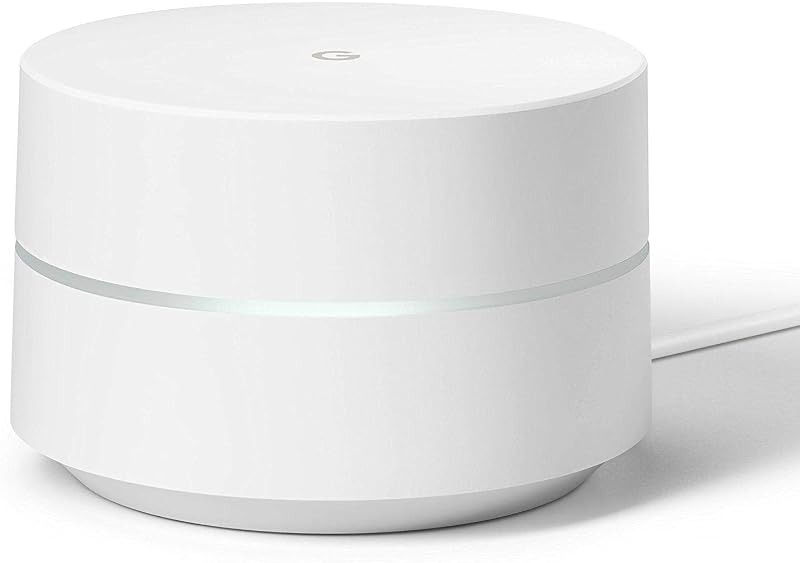
Best for: Apartments and foundational single-router setups
Pros
- Network Assist automated band switching
- Straightforward app-based management
- Equipped with 3 physical ports
Cons
- Coverage limited to 1500 sq ft
- Relies on older Wi-Fi 5 standard
Serving as an entry point for modular home networking, the single-pack Google WiFi System operates on legacy 802.11ac (Wi-Fi 5) protocols utilizing 2×2 Wave 2 technology alongside Bluetooth Low Energy. This standalone router replaces conventional gateway equipment to deliver coverage across spaces up to 1,500 square feet. The listing specifies a data throughput rating of 1200 Mbps (listed as 1200 MPBS throughput and 1200 megabytes per second transfer rate), utilizing internal antennas within a compact plastic chassis running a customized Linux-based operating system. Integrated Network Assist technology operates continuously in the background, automatically switching client hardware to the clearest wireless channel and fastest frequency band available.
Hardware connectivity on this base unit provides three physical ports and implements WPA3 security protocols to maintain authenticated access. Management functions are handled entirely through a companion mobile application, enabling administrators to visualize active connected devices, adjust device-specific traffic priorities, and pause network access on designated child devices. The listing notes that while this Google Wifi unit maintains complete operational compatibility with client devices using standard Wi-Fi protocols, it constitutes a standalone whole-home system that does not promise direct interoperability with third-party mesh solutions.
This model suits individuals outfitting compact apartments, studio flats, or secondary detached outbuildings requiring no more than 1,500 square feet of signal propagation. It functions effectively for routine office tasks, standard definition streaming, and foundational device connectivity. However, this single-point system gives way to multi-pack arrangements or the higher-throughput Nest Wifi Pro series when multi-floor structures demand unified roaming or when high-bandwidth multi-user households require 6 GHz transmission bands.
Google Nest WiFi Pro
Supplied in retail-boxed Snow packaging, this three-pack version of the Google Nest WiFi Pro represents the manufacturer’s flagship consumer mesh deployment for extensive properties. Covering up to 6,600 square feet across three coordinated routing nodes, this system operates on 802.11ax Wi-Fi 6E infrastructure spanning the 2.4 GHz, 5 GHz, and 6 GHz spectrums. The product listing highlights that the tri-band array is up to two times faster than standard Wi-Fi 6 hardware limited to 80 MHz channels. Running Google’s Nest OS, each router integrates automated diagnostics to correct operational errors independently while ensuring signal consistency remains intact even at extreme reception boundaries.
Hardware specifications include four physical connection ports per node, WPA3 encryption, and a designated LAN port bandwidth rated at 2.4 Gbps or higher, alongside a 1 Gbps general data transfer rate. Advanced operational modes stated in the listing encompass Access Point mode, dedicated Guest Mode, WPS pairing, built-in Internet Security protocols, and integrated LED operational indicators. Like all Nest Pro hardware, the listing confirms that this model cannot mesh with legacy Google Wifi or first-generation Nest Wifi units due to its distinct Wi-Fi 6E architecture.
This retail bundle is designed for expansive properties, multi-story residences, and smart residences packed with high-throughput hardware such as google nest camera wireless equipment. It offers a decisive answer for homeowners executing a complete google mesh wifi comparison who want certified retail hardware equipped with multi-gigabit LAN potential. It yields to smaller two-pack or single-node units when covering homes under 4,000 square feet to avoid redundant signal overlap.
Google WiFi Mesh Router System

Best for: Mid-sized homes wanting balanced dual-band value
Pros
- Covers up to 3800 sq ft
- Speeds rated up to 2.2 Gbps
- Flexible and scalable expansion
Cons
- Lacks 6 GHz wireless spectrum
- Port counts unspecified in listing
The two-pack Google WiFi Mesh Router System bridges the gap between single-point coverage and large enterprise setups, offering an aggregate operating range of up to 3,800 square feet. Relying on reliable Wi-Fi 5 (802.11ac) technology, this dual-band package is specified to deliver aggregate network throughput up to 2.2 Gbps (2200 Mbps) with a wired LAN port bandwidth of 1000 Mbps. The listing identifies compatibility across a wide spectrum of client hardware, including personal computers, mobile smartphones, gaming consoles, and network-attached printers, making it a versatile hub for diverse residential equipment.
Operating under a Linux firmware architecture, the system enforces secure wireless standards through WPA2-PSK and WPA3 security protocols. Network administrators manage the installation through mobile software, utilizing integrated parental controls to oversee home activity. The listing emphasizes the scalable, flexible nature of this hardware tier, noting that property owners can expand overall operational boundaries by incorporating supplemental Google Wifi points as their spatial coverage or client device counts expand over time.
This two-node arrangement is ideal for standard single-family homes, split-level residences, or medium-sized professional offices encompassing between 1,500 and 3,800 square feet. It provides dependable dual-band wireless for simultaneous streaming, browsing, and collaborative office duties without the higher system overhead of 6 GHz hardware. It gives way to the Nest Wifi Pro series when users maintain Wi-Fi 6E client devices or require dedicated 6 GHz backhaul performance to handle intensive file transfers.
Google Nest WiFi Pro 6E GA03030-US
The standalone Google Nest WiFi Pro 6E GA03030-US router delivers single-node Wi-Fi 6E operation tailored for intermediate square footage. Covering up to 2,200 square feet individually, this tri-band unit distributes traffic across 2.4 GHz, 5 GHz, and 6 GHz spectrum channels with a specified maximum data transfer rate of 2400 Mbps. Built with internal antennas and running a proprietary customized Linux OS, the router incorporates automated traffic management software that dynamically prioritizes real-time video conferencing data and routine website retrieval to minimize perceived network latency.
The device listing specifies a 1000 Mbps LAN port bandwidth connection, WPA3 security encryption, guest mode separation, and an app-driven management console. Automated background routines provide self-monitoring diagnostics to fix localized performance degradation autonomously, while secure booting features protect internal memory against unauthorized software modifications. The technical profile notes compatibility with client hardware such as personal computers and smartphones, while restating that the 6E wireless standard restricts backward mesh functionality with earlier Google Wifi iterations.
This single router fits modern urban condos, expansive single-floor loft apartments, or medium properties up to 2,200 square feet where high transmission speeds are required without deploying satellite nodes. It also functions as a targeted modular expansion unit for users who already operate a Nest Wifi Pro network and need to extend coverage into an annex or renovated wing. It gives way to pre-packaged multi-node bundles when multi-level walls impede single-source radio propagation.
Google Nest WiFi Pro
Presenting a two-node configuration in renewed condition, this package of the Google Nest WiFi Pro delivers an aggregate coverage rating of up to 4,400 square feet. Built around tri-band 802.11ax Wi-Fi 6E hardware, the system distributes connections across 2.4 GHz, 5 GHz, and 6 GHz frequencies. The listing highlights an upstream data transfer rate rating of up to 1920 Mbps, along with a 1000 Mbps LAN port bandwidth, making it suitable for symmetrical high-speed internet connections and demanding domestic cloud synchronization.
Software features detailed in the listing include comprehensive access point mode settings, WPS connectivity, integrated LED visual indicators, parental controls, and isolated guest access configurations managed via application software. The device utilizes WPA2-PSK and WPA3 security protocols running on a Linux OS platform. The listing highlights edge-of-network consistency optimization alongside internal autonomous issue resolution, ensuring that mobile devices traversing between the two nodes experience seamless handoffs.
This two-pack configuration suits medium-to-large suburban properties ranging between 2,500 and 4,400 square feet where dual routing points provide adequate spatial distribution across two floors. It offers a practical path for network administrators deciding which google mesh wifi to buy when outfitting homes with modern smart equipment like a google speaker nest ecosystem. It yields to the three-pack Pro system when domestic square footage exceeds 4,400 square feet or when intricate masonry requires a third mesh node.
Matching a Model to Your Setup
- Expansive Multi-Story Homes (Up to 6,600 Sq. Ft.): The Google Nest WiFi Pro (3-Pack, Retail) or its non-retail packaging variant delivers complete three-node tri-band coverage across 2.4 GHz, 5 GHz, and 6 GHz spectrums to eliminate dead zones in properties with extensive structural boundaries.
- Standard Two-Story Residences (Up to 4,400 Sq. Ft.): The Google Nest WiFi Pro (2-Pack, Renewed) supplies two balanced Wi-Fi 6E points capable of sustaining multi-device loads and high upstream data rates across intermediate layouts.
- Mid-Sized Single-Family Homes (Up to 3,800 Sq. Ft.): The Google WiFi Mesh Router System (2-Pack) provides an economical dual-band Wi-Fi 5 setup that handles simultaneous streaming, office peripherals, and mobile clients up to 2.2 Gbps without unnecessary hardware complexity.
- Urban Lofts and Modern Condos (Up to 2,200 Sq. Ft.): The Google Nest WiFi Pro 6E GA03030-US single-pack covers moderate footprints with high-speed tri-band routing, 2400 Mbps transfer capabilities, and low-latency 6 GHz channel access.
- Compact Apartments or Modular Outbuildings (Up to 1,500 Sq. Ft.): The Google WiFi System (1-Pack) delivers simple, self-optimizing dual-band Wi-Fi 5 routing with three ports and Network Assist automation tailored for smaller spaces.
Before You Buy
Before selecting hardware from this catalog, note that the listings do not specify several architectural details regarding wired backhaul topologies or internal spatial stream antenna counts. While the Nest Wifi Pro hardware outlines LAN bandwidth capabilities ranging from 1000 Mbps up to 2.4 Gbps across different listings, product specifications do not clearly state the precise number of usable physical Ethernet jacks on every node within multi-pack bundles versus standalone gateway units. Additionally, the listings do not detail whether individual nodes feature independent switching chips for hardwired switch pass-through, meaning households requiring extensive wired connections for servers or workstations must plan for supplemental unmanaged network switches.
A critical compatibility barrier highlighted in the product specifications is that Wi-Fi 6E Nest Wifi Pro systems cannot communicate or form a joint mesh network with legacy Wi-Fi 5 Google Wifi hardware. The manufacturer listings leave no ambiguity regarding this limitation: if you possess an existing Google Wifi or older Nest Wifi setup, adding a Nest Wifi Pro point will not extend that network; it requires replacing the original infrastructure entirely. Furthermore, product listings do not supply information regarding compatibility with third-party mesh extenders, meaning network expansions must rely exclusively on matching hardware points within the identical product generation.
FAQ
Can Google Nest WiFi Pro nodes mesh with an existing Google WiFi system?
No. The listings explicitly specify that Nest Wifi Pro utilizes advanced Wi-Fi 6E technology and is not compatible with previous generations of Google Wifi or standard Nest Wifi devices. Creating a unified mesh network requires deploying nodes from the same product tier.
What practical advantage does the 6 GHz band provide on Nest Wifi Pro?
The 6 GHz band introduced on the Nest Wifi Pro provides an uncongested wireless frequency separate from crowded 2.4 GHz and 5 GHz channels. The listings state this enables speeds up to twice as fast as Wi-Fi 6 routers operating on standard 80 MHz channels, reducing latency for compatible client devices.
How does Google Network Assist manage connected devices?
Network Assist is an automated software feature on the Google Wifi system that continuously monitors environmental interference. It automatically switches connected client devices to the clearest available radio channel and fastest frequency band without requiring manual network administration.
Are Ethernet ports available on all Google mesh points?
Listing specifications confirm physical ports on specific units, such as four ports on the Nest Wifi Pro 3-pack and three ports on the single-pack Google Wifi system. However, specific port distributions across secondary satellite points versus primary gateway routers are not explicitly detailed in every listing.
Can I expand my Google mesh system coverage later?
Yes. The listings for both the Google Wifi family and Nest Wifi Pro state that the setups are scalable, allowing users to add additional compatible points over time to accommodate larger domestic footprints or expanding device inventories within the same product generation.
Selecting the right hardware ultimately depends on whether your home demands the dedicated 6 GHz speeds of the Nest Wifi Pro or the practical affordability of standard Google Wifi nodes. Mapping your floor plan, wall materials, and active device count will reveal which configuration prevents dead zones without excess spending. For a broader walkthrough on antenna placement, backhaul options, and coverage optimization across different brands, consult our comprehensive Mesh WiFi Guide before finalizing your deployment.