Jackery Solar Generator Comparison: Choosing the Right Power Station
Evaluating solar backup electrical systems requires balancing usable energy capacity, continuous wattage ratings, peak surge delivery, and physical mobility.

What this report covers
- Models assessed
- 3
- Our score range
- 9.0 – 9.4/10
- Last updated
- 25 Sep 2026
Figures above are read from the product listings for the models named below. Scores are out of 10, based on listed specifications and buyer feedback.
As Amazon Associates, we earn from qualifying purchases. This means we may receive a small commission at no extra cost to you if you click through and make a purchase.
Evaluating solar backup electrical systems requires balancing usable energy capacity, continuous wattage ratings, peak surge delivery, and physical mobility. Choosing the right power station depends directly on whether your operational priority centers on running mobile computing devices and field gear during travel or keeping heavy domestic appliances energized during extended power outages. While compact units focus on minimal carry weight and rapid solar deployment for field professionals, whole-house systems demand massive watt-hour reserves, dual-voltage split-phase output, and direct integration with home transfer switches. Navigating these options requires assessing your actual appliance draw, anticipated runtimes, and the physical demands of your installation setup.
Jackery structures its power station catalog across distinct capacity tiers, battery chemistries, and installation configurations. The lineup transitions from ultra-portable stations engineered for mobile outdoor use up to industrial-grade domestic resilience hubs featuring high-temperature ceramic membrane cells and split-phase power delivery. Across this range, a detailed jackery solar generators comparison makes it straightforward to determine which jackery solar generator to buy based on continuous load profiles and expansion potential. Whether your setup calls for a lightweight off-grid companion or a robust portable solar generator for home backup, evaluating these models against verified manufacturer specifications reveals the best jackery solar generator for your operational requirements.
Criteria matrix What each model in this report is credited with
Rows are the criteria that come up in the pros and cons listed for this lineup. A check means the criterion is named in this report’s write-up of that model; a dash means it is not. Criteria that apply to every model, or to only one, are left out because they separate nothing.
| Criterion | Solar Generator 300 and 9.2/10 | HomePower 3600 Plus Portable 9.0/10 | Solar Generator 5000 Plus 9.4/10 |
|---|---|---|---|
| Solar panels | Not named | Named | Named |
| LiFePO4 | Named | Not named | Named |
| Native | Not named | Named | Named |
| Cycles | Named | Named | Not named |
| Surge | Named | Not named | Named |
| Large | Named | Not named | Named |
| Criteria named | 4 / 6 | 3 / 6 | 5 / 6 |
Built from the wording of this report, not from a bench test. A dash is not a fault: it only means the write-up does not mention that point for that model. Scores next to each model are out of 10, based on listed specifications and buyer feedback.
Jackery Solar Generators Lineup at a Glance

Best for: Whole-home backup and 240V appliances
Pros
- 7200W output with 14,400W surge
- Native split-phase 120V/240V output
- Expandable up to 60kWh capacity
Cons
- Solar panels sold separately
- Large physical footprint
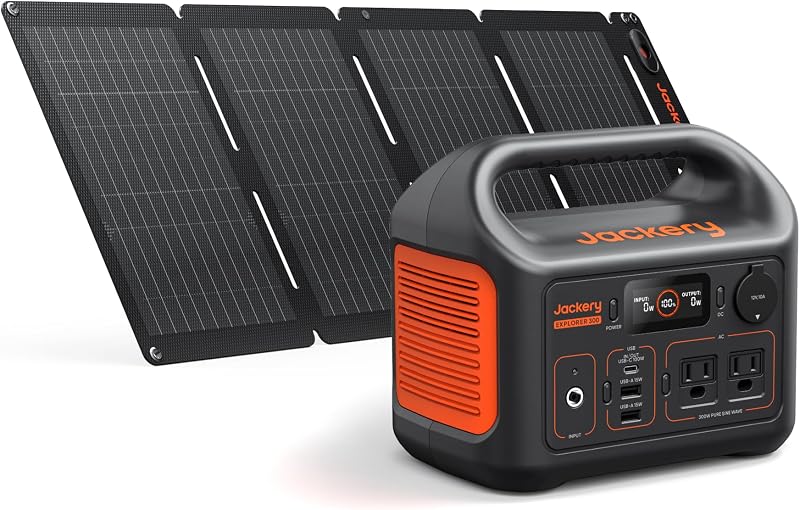
Best for: Mobile field work and camping
Pros
- Weighs only 7.5 pounds
- Over 4,000 LiFePO4 cycles
- Fast 100W USB-C PD port
Cons
- Limited 300W continuous output
- No battery expansion capability
| Model | Storage Capacity and Chemistry | Continuous and Peak Output | Recharging Specs |
|---|---|---|---|
| Jackery Solar Generator 300 and 40W | 292Wh LiFePO4 (Over 4,000 cycles to 70% capacity) | 300W running (600W peak surge) | 80% in 2.8 hours with 100W solar; 80% in 7.5 hours with 40W solar |
| Jackery HomePower 3600 Plus Portable Power | 3584Wh ceramic membrane LFP (6,000 cycles; expandable to 21kWh or 43kWh) | 3600W running (7200W in parallel); 120V and 240V in parallel | Hybrid AC+DC in 2 hours; AC in 2.5 hours; solar in 4 hours; gas generator in 2.5 hours |
| Jackery Solar Generator 5000 Plus Portable | 5040Wh LiFePO4 (ChargeShield 2.0; expandable to 60kWh) | 7200W running (14,400W peak surge); native 120V/240V | Up to 4000W solar input (recharge in ~2 hours); high- and low-voltage array support |
The Models in Detail
Jackery Solar Generator 300 and 40W
The Jackery Solar Generator 300 and 40W serves as the brand’s ultra-lightweight entry point, packing 292 watt-hours of electrical storage into an enclosure weighing only 7.5 pounds. Engineered to be 17 percent lighter than the industry average in its performance class, this unit incorporates a sleek, integrated carry handle that makes it effortless to transport during extended hikes, remote job sites, and field research trips. The internal battery platform features an upgraded jackery lifepo4 power station chemistry that provides over 4,000 charge cycles before dropping to 70 percent capacity, delivering more than 11 years of reliable operational service. For professionals who operate off-grid field gear or maintain an isolated reolink security camera system solar setup, this compact unit offers dependable long-term cycle durability without loading down your vehicle or field pack.
In terms of electrical output, the station supplies 300 watts of continuous running power with a 600-watt peak surge capacity through a 120-volt alternating current delivery system. The interface is engineered to power up to six devices at the same time, offering two AC outlets, a high-speed 100W USB-C Power Delivery port, two USB-A ports, and a 120W 12V car port. This outlet balance readily supports field laptops, professional drones, cameras, communications hardware, and compact refrigeration units. While a pocket-sized jackery portable charger works well for handheld smartphones, this full-featured station supplies regulated alternating and direct current to keep an entire remote workstation running during off-grid operations.
Off-grid replenishment is optimized for fast turnaround when paired with compatible solar equipment. Connected to the included 40W Air solar panel, the Explorer 300 reaches an 80 percent charge state in approximately 7.5 hours of optimal sunlight, while an optional 100W solar panel shortens that recharge window to roughly 2.8 hours. The package includes the Explorer 300 portable power station, one 40W Air solar panel, an AC adapter, a 12V car charger cable, and an instruction manual. The manufacturer listing notes that the generator and solar panel may ship separately. While exceptional for mobile field professionals and weekend campers, its 300W continuous rating cannot run large household appliances, making the larger domestic units necessary for residential blackouts.
Jackery HomePower 3600 Plus Portable Power
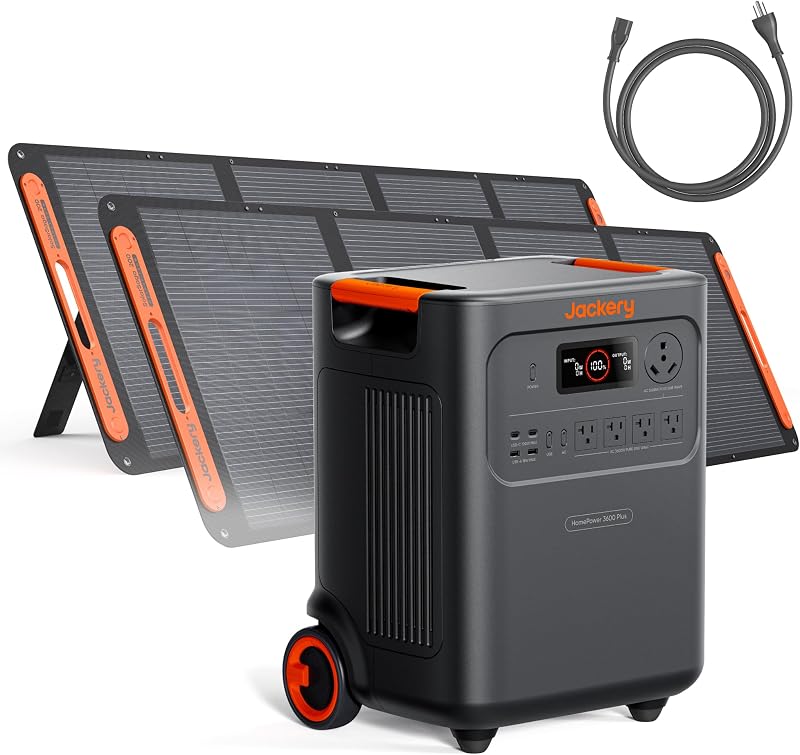
Best for: Residential backup and cold climates
Pros
- Expandable up to 43kWh capacity
- Operates down to -4 °F
- Fast two-hour hybrid recharge
Cons
- Heavier 77.2-pound unit weight
- Requires parallel unit for 240V
Moving up to residential-scale energy security, the Jackery HomePower 3600 Plus Portable Power system delivers substantial output designed for essential household resilience. With a base capacity of 3584 watt-hours, this station delivers 3600 watts of continuous AC output, supporting dual-voltage 120V and 240V operation when connected in parallel to achieve 7200 watts of continuous power. Built with automotive-grade cell-to-body technology, the chassis is 34 percent smaller and 29.3 percent lighter than competing power stations in the 3.6kWh category. The station weighs 77.2 pounds and measures 15.2 by 12.2 by 19.3 inches, incorporating a luggage-style telescopic handle and integrated heavy-duty transport wheels that make it practical to roll between living rooms, utility spaces, and storage areas.
The battery platform uses high-temperature resistant ceramic membrane cells tested up to 302 degrees Fahrenheit to prevent thermal runaway caused by high ambient heat or continuous heavy loads. Rated for 6,000 charge cycles and a 10-year lifespan, this jackery emergency backup generator maintains reliable discharge capability in extreme conditions, functioning smoothly even during -4 degrees Fahrenheit blizzards. For residential backup, it operates as a plug-and-play solution when paired with a manual transfer switch, allowing homeowners to power a three-person household by running critical branch circuits like kitchen refrigerators, sump pumps, well pumps, and space heaters during municipal power cuts.
Recharge versatility is supported by four distinct input methods designed to minimize downtime during emergencies. Using hybrid AC and DC charging, the internal battery pack can reach a complete 100 percent recharge in two hours. Independent charging paths provide a full recharge via standard AC wall power in 2.5 hours, dedicated solar input in 4 hours using the two included 200W solar panels, or an external gas generator in 2.5 hours. While its 3584Wh capacity can expand up to 21kWh per unit or 43kWh using linked units, homeowners who require native, standalone 240V split-phase power for massive appliances without a parallel linking unit will prefer the larger 5000 Plus platform.
Jackery Solar Generator 5000 Plus Portable
The Jackery Solar Generator 5000 Plus Portable stands as the highest-capacity standalone power station in the brand catalog, engineered specifically for whole-home emergency power and high-draw commercial equipment. Delivering a massive 7200 watts of continuous rated power with a 14,400-watt starting surge capacity, it provides native 120V and 240V dual-voltage output directly from a single unit. Operating with a 30-amp current rating and an engine power maximum of 14.4 kilowatts, this machine handles heavy-draw inductive appliances that overwhelm smaller backup units, such as 5-ton central air conditioners, whole-house water heaters, and workshop machinery.
The core storage architecture is powered by a 5040 watt-hour LiFePO4 battery pack equipped with ChargeShield 2.0 protection technology, rated for up to 11 years of continuous daily use. For extended disaster preparedness, the station supports modular battery expansion up to 60kWh, providing sufficient stored energy to maintain household operations for up to 13 consecutive days during prolonged winter storms or regional blackout events. Home integration is designed around the Jackery 60A Smart Transfer Switch, which allows the system to manage up to 12 branch circuits at 120V or 6 circuits at 240V, automating essential household power delivery without requiring extension cords strung across living spaces.
Photovoltaic input on this model is built for serious off-grid generation, accepting up to 4000 watts of solar input across both high-voltage and low-voltage solar arrays to complete a full battery recharge in approximately two hours under clear sky conditions. This high input acceptance makes the station exceptionally versatile for residential emergency backup, rural off-grid homesteads, and large recreational vehicles. The product listing specifies that solar panels are optional for this particular configuration. While its 7200W output and native 240V support make it an outstanding emergency power hub, its substantial physical scale is tailored for stationary residential use rather than lightweight field portability.
Matching a Model to Your Setup
- Mobile Field Operations and Outdoor Workstations: Professionals powering field laptops, cameras, drones, and test equipment should select the Jackery Solar Generator 300 and 40W for its lightweight 7.5-pound chassis and included folding solar panel.
- Residential Blackout and Critical Food Storage: Homeowners who need to maintain uninterrupted power for full-sized refrigerators, kitchen appliances, and basic household medical equipment should deploy the Jackery HomePower 3600 Plus Portable Power.
- Heavy 240-Volt Appliance and HVAC Backup: Households requiring continuous power for 5-ton central air conditioning systems, electric water heaters, and 240V well pumps require the 7200W continuous output and native split-phase delivery of the Jackery Solar Generator 5000 Plus Portable.
- Severe Winter Climate Readiness: Properties in regions subject to sub-zero blizzards should choose the Jackery HomePower 3600 Plus Portable Power, taking advantage of its thermal-runaway-resistant ceramic membrane cells rated for operation down to -4 degrees Fahrenheit.
- Multi-Week Off-Grid Independence: Users requiring extensive energy reserves capable of powering home circuits through extended utility failures should select the Jackery Solar Generator 5000 Plus Portable expanded up to its maximum 60kWh capacity.
Before You Buy
Before purchasing your power station, consider the specific packaging and shipping terms detailed in the product listings. Multi-component solar generator bundles often ship in separate packages because of shipping carrier weight and size constraints. The Jackery Solar Generator 300 listing explicitly notes that the power station and the 40W Air solar panel may ship in separate boxes under different tracking numbers. Similarly, while the HomePower 3600 Plus package includes two 200W solar panels alongside an AC charging cable, the listing for the Solar Generator 5000 Plus specifies that solar panels are optional. Buyers planning an off-grid solar recharge setup for the 5000 Plus will need to order compatible solar panels separately.
Home electrical integration also requires specific equipment and planning that the core product listings do not supply. Connecting the HomePower 3600 Plus to your home circuits requires an external manual transfer switch, while using the Solar Generator 5000 Plus for home circuits requires the Jackery 60A Smart Transfer Switch to manage split-phase power across 12 branch circuits. The power station listings do not include transfer switches, subpanel wiring, conduit, or installation hardware, requiring buyers to arrange installation with a qualified licensed electrician. Additionally, while both the 3600 Plus and 5000 Plus support modular expansion up to 43kWh and 60kWh respectively, external expansion batteries and connecting cables are separate purchases that are not bundled in these listings.
FAQ
Which Jackery solar generator can run 240-volt home appliances directly?
The Jackery Solar Generator 5000 Plus Portable provides native 120V and 240V split-phase alternating current output directly from its main interface. This allows it to drive heavy 240-volt residential appliances, including 5-ton central air conditioning units and domestic water heaters, without any external voltage transformer. The Jackery HomePower 3600 Plus can also output 240V, but only when two units are connected in parallel. The compact Jackery Solar Generator 300 supports only standard single-phase 120V AC output.
How does the LiFePO4 battery lifespan compare across these Jackery models?
All three models use long-lasting lithium iron phosphate (LiFePO4) battery chemistries, though their cycle ratings differ across chassis designs. The Jackery Solar Generator 300 delivers over 4,000 charge cycles before reaching 70 percent capacity, representing more than 11 years of regular use. The Jackery HomePower 3600 Plus uses high-temperature ceramic membrane cells rated for 6,000 cycles and a 10-year lifespan, functioning in temperatures down to -4 degrees Fahrenheit. The Jackery Solar Generator 5000 Plus features ChargeShield 2.0 technology with cells rated for up to 11 years of daily use.
Can you expand the battery capacity on all Jackery solar generators?
No, battery expansion is only available on the larger residential models. The Jackery Solar Generator 300 has a fixed internal capacity of 292 watt-hours with no listing support for external expansion packs. In contrast, the Jackery HomePower 3600 Plus features a 3584 watt-hour base capacity that expands up to 21 kilowatt-hours per unit or 43 kilowatt-hours when combining multiple units. The Jackery Solar Generator 5000 Plus starts at 5040 watt-hours and expands up to 60 kilowatt-hours using modular battery packs.
What solar panels are included with each Jackery generator package?
The included equipment differs significantly across each package listing. The Jackery Solar Generator 300 bundle includes one 40W Air solar panel along with an AC adapter and 12V car charger cable. The Jackery HomePower 3600 Plus listing includes an AC power cable and two 200W solar panels for a total of 400W solar generation. The Jackery Solar Generator 5000 Plus listing title specifies that solar panels are optional, meaning panels are not included in that package and must be purchased separately to utilize its 4000W solar input capacity.
How do these Jackery solar generators connect to a home breaker panel?
The Jackery Solar Generator 300 is designed strictly for portable direct plug-in use and cannot be connected to a residential breaker panel. The Jackery HomePower 3600 Plus connects to residential wiring through a manual transfer switch to power selected household circuits during an outage. The Jackery Solar Generator 5000 Plus interfaces with home electrical systems through a Jackery 60A Smart Transfer Switch, allowing it to power up to 12 individual 120V circuits or 6 dedicated 240V circuits to keep essential household appliances running smoothly.


