The Professional Toyo Glass Cutter Guide: Comparing Top Scoring Tools
Selecting an industrial toyo cutter for glass requires evaluating wheel grind angles, lubrication feeds, and handle ergonomics against specific workpiece thicknesses.

What this report covers
- Models assessed
- 6
- Our score range
- 8.6 – 9.8/10
- Last updated
- 25 Sep 2026
Figures above are read from the product listings for the models named below. Scores are out of 10, based on listed specifications and buyer feedback.
As Amazon Associates, we earn from qualifying purchases. This means we may receive a small commission at no extra cost to you if you click through and make a purchase.
Selecting an industrial toyo cutter for glass requires evaluating wheel grind angles, lubrication feeds, and handle ergonomics against specific workpiece thicknesses. Glaziers, stained glass fabricators, and custom glassworkers face varying demands on scoring pressure and hand fatigue, making the distinction between standard fixed carbide wheels and micro-vibrating tap wheels critical. Knowing which toyo glass cutter to buy depends on whether your daily workflow favors straight-line scoring along guide rails, freehand pattern tracing, or maintaining existing tools with fresh cutting heads and lubricating fluids.
The manufacturer organizes its scoring catalog into dedicated handheld supercutters, specialized lubrication formulas, and modular replacement components engineered around durable tungsten carbide. The core lineup centers on the renowned toyo supercutter platform, which divides into standard straight brass barrels, tap-wheel variations that drive fractures deeper with less effort, and slender pencil-grip styles. Supporting these tools are accessories like the toyo tc17h replacement head and purpose-formulated toyo glass cutting oil, creating an adaptable system where handles endure across years of production while scoring wheels and fluids are replenished as needed.
Criteria matrix What each model in this report is credited with
Rows are the criteria that come up in the pros and cons listed for this lineup. A check means the criterion is named in this report’s write-up of that model; a dash means it is not. Criteria that apply to every model, or to only one, are left out because they separate nothing.
| Criterion | TOYO TC17B 9.4/10 | TOYO TC17BV 8.6/10 | Brass Oil Fed Pencil 9.0/10 | TOYO | Oil Glass Cutter Cutting 9.8/10 | Large Carbide REP.Glass Cutter 8.6/10 |
|---|---|---|---|---|---|---|
| Tungsten carbide wheel | Not named | Named | Not named | Named | Not named | Named |
| Brass barrel | Named | Named | Not named | Not named | Named | Not named |
| Reservoir | Named | Named | Not named | Not named | Named | Not named |
| Automatic | Not named | Not named | Named | Named | Named | Not named |
| Pressure | Named | Named | Named | Not named | Not named | Not named |
| Handle | Not named | Named | Not named | Not named | Named | Named |
| Cutter head | Not named | Not named | Named | Not named | Not named | Named |
| Wheel angle | Not named | Named | Not named | Not named | Named | Not named |
| Criteria named | 3 / 8 | 6 / 8 | 3 / 8 | 2 / 8 | 5 / 8 | 3 / 8 |
Built from the wording of this report, not from a bench test. A dash is not a fault: it only means the write-up does not mention that point for that model. Scores next to each model are out of 10, based on listed specifications and buyer feedback.
Toyo Glass Cutters Lineup at a Glance

Best for: Lubricating all Supercutter tool wheels
Pros
- Engineered non-gumming viscosity
- High-visibility blue tint
- Anti-rust protective formula
Cons
- Bottle only without cutter
| Model | Tool Type | Wheel Angle and Range | Key Design Feature |
|---|---|---|---|
| TOYO TC17B | Straight Supercutter | 140° (2 mm to 6 mm) | Precision-honed brass barrel with roll-stop cap |
| TOYO TC17BV | TAP Wheel Supercutter | 140° (2 mm to 6 mm) | Micro-vibrating tap wheel for deeper fissures |
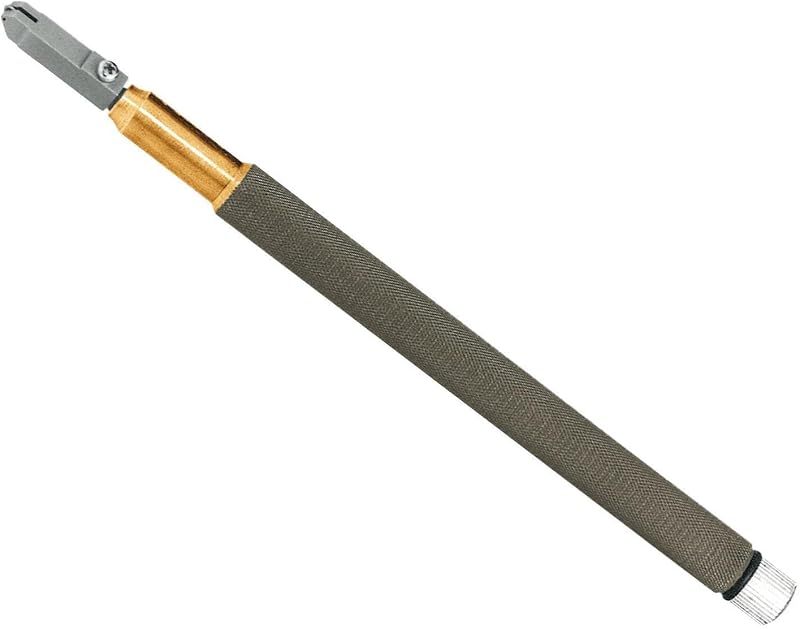
| Toyo Brass Oil Fed Pencil Style | Pencil Supercutter (#Tc10b) | Carbide steel wheel | Cross-hatched textured grip for freehand control |
| TOYO | Cutting Oil (4 oz) | Engineered viscosity | Rust-resistant formula with Yorker pour top |
| Toyo Oil Glass Cutter Cutting Angle | TAP Wheel Supercutter | 138° (2 mm to 10 mm) | Integrated 2.5 mm straightedge offset distance |
| Toyo Large Carbide REP.Glass Cutter Head | Replacement Head (TC17H) | 140° (Straight cuts) | Tungsten carbide wheel fits multiple Toyo bodies |
The Models in Detail
TOYO TC17B

Best for: Standard straight float glass scoring
Pros
- Precision tungsten carbide wheel
- Durable brass barrel
- Anti-roll hexagonal cap
Cons
- Requires steady manual pressure
The TOYO TC17B serves as the foundational benchmark in any toyo glass cutter comparison. Originally introduced in 1975, this self-oiling straight supercutter features a precision-honed tungsten carbide scoring wheel ground to a 140° cutting angle. That profile is optimized specifically for glass thicknesses between 3/32 inch (2 mm) and 1/4 inch (6 mm). The sturdy brass barrel functions as a continuous fluid reservoir, feeding oil to the scoring wheel during movement. Weighing 2.82 ounces with dimensions of 7 by 0.5 by 0.63 inches, the tool incorporates a hexagonal end cap that prevents it from rolling off slanted cutting surfaces.
This model is the best toyo cutter for glass professionals who cut long runs of standard float glass using straightedges, T-squares, or cutting tables. Its solid brass weight provides natural downward balance, reducing the need for aggressive operator force. However, when working with harder compositions or panes approaching maximum sheet thickness, the fixed-wheel design gives way to the vibrating tap-wheel models. Glass artisans who also utilize manual cutting tools in other media, such as printmakers reviewing our speedball lino cutter guide, will recognize the value of the TC17B barrel balance for straight-line stability.
TOYO TC17BV

Best for: Thicker glass with reduced pressure
Pros
- Vibrating TAP Wheel technology
- Deep score penetration
- Sturdy brass reservoir
Cons
- Slightly heavier than standard
Equipped with specialized internal mechanics, the TOYO TC17BV pairs the heavy brass barrel of the classic supercutter series with proprietary TAP Wheel technology. The internal cam mechanism creates micro-vibrations as the wheel rolls along the surface, driving fissure lines deeper into the glass with substantially less downward pressure. The toyo tc17bv features the standard 140° tungsten carbide wheel angle suited for glass thicknesses from 3/32 inch (2 mm) to 1/4 inch (6 mm). Weighing 2.89 ounces, it includes the same anti-roll hexagonal end cap and integrated oil reservoir system found on traditional straight models.
This toyo tap wheel cutter is built for glaziers dealing with harder glass compositions or fabricators experiencing hand strain during long production shifts. The vibrating wheel ensures clean, continuous fissures that break out smoothly without requiring secondary scoring runs. While exceptionally effective for heavy straight scoring, glazier technicians who prefer an ultra-narrow pencil grip for intricate pattern work may find this cylindrical brass handle bulkier than dedicated pencil-style variants.
Toyo Brass Oil Fed Pencil Style
Best for: Freehand curves and stained glass
Pros
- Sure-grip cross-hatched barrel
- Pressure-activated automatic oiling
- Replaceable cutter head
Cons
- Narrower grip for heavy leverage
The Toyo Brass Oil Fed Pencil Style, cataloged under part number toyo tc10b (model number 4336850049), is designed for artisans requiring high dexterity. Unlike smooth straight barrels, this model features a cross-hatched metal barrel that delivers positive tactile feedback and slip-resistant handling. The self-oiling mechanism operates when downward pressure is applied against the durable carbide steel wheel, preventing oil pooling while keeping the scoring wheel rolling freely. The unit weighs 3.2 ounces, measures 1 by 0.7 by 7 inches, and features a replaceable cutter head assembly.
Artisans crafting stained glass panels, intricate curved borders, or artistic mosaic segments will appreciate the pencil grip orientation, which is held between the fingers rather than gripped in the palm. It offers exceptional rotational agility along tight curves where wider barrels feel cumbersome. For heavy architectural installations or industrial sheet separation, this pencil tool yields to the heavier straight-handled TC17 series. Production crews looking across various specialized shop implements like those in our dewalt cable cutter breakdown will value the durable all-metal construction of the TC10B handle.
TOYO
Formulated specifically for handheld tools and automatic cutting machines, this 4-ounce bottle of TOYO glass cutting oil provides the lubrication necessary for consistent score lines. Manufactured and bottled in the United States, this lubricant features an engineered viscosity that flows smoothly through the internal wicks and valves of Supercutters without gumming up or creating dry spots. The fluid includes rust inhibitors to protect delicate tungsten carbide wheel axles from moisture corrosion. It comes in a 4-fluid-ounce bottle equipped with a narrow Yorker pour top for clean refills, and features a light blue tint that allows fabricators to monitor fluid levels easily.
This lubricant is intended for commercial glazing contractors, architectural glass fabricators, automotive technicians, and stained glass hobbyists working with float glass, mirrors, bottles, and tiles. Dry scoring accelerates wheel dulling and generates jagged edge fractures, making dedicated cutting oil an essential companion to any Toyo handle. Note that this product is strictly a maintenance lubricant and does not include cutting handles or scoring components.
Toyo Oil Glass Cutter Cutting Angle
Best for: Scoring panels up to 10 millimeters
Pros
- Extended 2 to 10 mm range
- Patented tap wheel vibration
- Precise 2.5 mm straightedge offset
Cons
- Specific 138-degree wheel angle
The Toyo Oil Glass Cutter Cutting Angle model incorporates a 138° wheel angle and integrated tap-wheel technology within a classic brass TC 17 B housing. This specific 138° wheel geometry, combined with the micro-vibrating tap mechanism, expands the tool’s working range to handle glass thicknesses from 2 mm up to 10 mm. The brass barrel houses an internal oil reservoir with an automatic dispensing system that lubricates the carbide wheel upon contact. The cutter specifies a straight edge measuring distance of 2.5 mm, allowing operators to position alignment rules with exact precision.
This cutter is tailored for commercial glazing shops and field technicians handling an assortment of glass types, from standard 2 mm window panes to heavy 10 mm architectural panels. The 2.5 mm edge-offset measurement simplifies layout calculations during rapid job site framing. Much like automotive locksmiths rely on exact spatial references with an xhorse key cutting machine, glaziers rely on this tool’s precise straightedge offset to guarantee exact final dimensions. For dedicated thin-glass operations where a 140° angle is preferred, the standard TC17B remains the standard option.
Toyo Large Carbide REP.Glass Cutter Head
Best for: Restoring worn TC17 cutter handles
Pros
- 140-degree tungsten carbide wheel
- Broad handle model compatibility
- Quick OEM replacement
Cons
- Requires existing cutter handle
The Toyo Large Carbide REP.Glass Cutter Head, model TC17H, is an OEM replacement assembly designed to restore original factory scoring precision to existing cutter handles. Built around a high-grade tungsten carbide wheel with a 140° cutting angle, this large head is engineered specifically for clean, straight score lines across float glass. The head measures 1 by 0.75 by 0.75 inches, weighs 1 ounce, and provides direct compatibility with Toyo handles including the TC17B, TC17P, TC1S, TC600S, TC70, TC70SB, and TC9.
This replacement component suits busy studios and industrial glazing facilities that generate high daily mileage and need to restore scoring edges without discarding durable brass handles. Installing a fresh head eliminates score skipping, chipped edges, and inconsistent breakouts caused by worn carbide wheels. Because the TC17H is solely a replacement head, it requires an existing compatible Toyo handle body to function.
Matching a Model to Your Setup
- High-volume straight-edge scoring on 2 mm to 6 mm float glass: Choose the TOYO TC17B for its balanced brass barrel, 140° carbide wheel, and roll-stop cap.
- Cutting thicker sheet glass with minimal manual downward effort: Select the TOYO TC17BV to utilize its micro-vibrating TAP Wheel mechanism.
- Stained glass crafting and intricate curved pattern work: Pick the Toyo Brass Oil Fed Pencil Style (#Tc10b) for its cross-hatched grip and nimble fingertip control.
- Commercial glazing across variable 2 mm to 10 mm panel thicknesses: Deploy the Toyo Oil Glass Cutter Cutting Angle with its 138° wheel and 2.5 mm straightedge offset.
- Restoring dull scoring edges on existing TC17-compatible cutter bodies: Install the Toyo Large Carbide REP.Glass Cutter Head to regain clean factory breaks.
- Eliminating wheel chatter and preventing internal tool corrosion: Use TOYO glass cutting oil in your handle reservoir for clean fluid flow.
Before You Buy
While Toyo Supercutters are precision tools built for long service lives, buyers should note what is omitted from standard retail packages. The handheld scoring tools, including the TC17B, TC17BV, and TC10B, feature internal oil reservoirs and automatic dispensing systems, but the product listings do not specify that cutting oil is included in the package. Users must obtain compatible cutting fluid separately to ensure proper wheel lubrication and prevent micro-chipping along score margins.
Additionally, the listings do not specify the inclusion of running pliers, breaker bars, glass cutting squares, or personal protective equipment. The TC17H replacement head listing does not include spare mounting screws or retaining pins, requiring users to retain their existing handle hardware during maintenance. Artisans working on custom upcycling projects such as repurposing large ball jars should remember that scoring tools only create the initial surface fissure; mechanical running pliers or thermal breakout methods are still required to complete glass separation.
FAQ
What is the difference between the Toyo TC17B and TC17BV?
The TC17B uses a standard fixed tungsten carbide wheel suited for straight-line scoring on float glass. The TC17BV features patented TAP Wheel technology, which introduces micro-vibrations as the wheel turns. This vibration drives the score fissure deeper into the glass while requiring less physical downward pressure from the operator.
Can the cutter head be replaced on the Toyo TC10B pencil cutter?
Yes, the product listing explicitly confirms that cutter heads are replaceable on the Toyo TC10B pencil-style cutter. This allows craftspeople to retain the cross-hatched brass handle permanently while swapping out the carbide wheel assembly when it shows wear.
Which tool handles accept the TC17H replacement head?
The TC17H replacement head is compatible with a wide range of Toyo cutter handles, including the TC17B, TC17P, TC1S, TC600S, TC70, TC70SB, and TC9. It is designed for straight-line cutting with a 140° tungsten carbide wheel.
Why is dedicated glass cutting oil necessary in Toyo Supercutters?
Dedicated cutting oil has a calibrated viscosity that flows consistently through internal tool reservoirs without gumming up the valve or skipping. It lubricates the wheel axle, inhibits rust formation, and keeps the score line cool and open for a clean mechanical break.
What glass thicknesses can the 138-degree Toyo cutter accommodate?
According to its listing specifications, the Toyo 138° cutter is suitable for glass thicknesses ranging from 2 mm to 10 mm. It features tap-wheel vibration technology and a 2.5 mm straightedge offset distance for accurate layout alignment.


