Westinghouse Tri-Fuel Inverter Generator Guide: Top Models Compared
Selecting an emergency backup generator involves balancing fuel flexibility, wattage output, and power quality for modern household appliances.

What this report covers
- Models assessed
- 6
- Buyer rating range
- 4.0 – 4.9 of 5
- Last updated
- 23 Sep 2026
Figures above are read from the product listings for the models named below. Ratings are the average left by Amazon buyers, not a score awarded here.
As Amazon Associates, we earn from qualifying purchases. This means we may receive a small commission at no extra cost to you if you click through and make a purchase.
Selecting an emergency backup generator involves balancing fuel flexibility, wattage output, and power quality for modern household appliances. Homeowners facing power outages must decide between quiet, enclosed inverter units and high-capacity open-frame generators. Operating a westinghouse tri fuel portable generator allows seamless switching between gasoline, liquid propane, and utility natural gas. Each fuel provides different output levels, with natural gas consistently delivering lower running wattage than propane or gasoline. Determining the right unit requires assessing whether your home needs clean power for microprocessors, high starting amperage for central cooling, or extended runtimes during multi-day emergencies.
The Westinghouse tri-fuel lineup is divided into two distinct families: the quiet iGen inverter models and the heavy-duty WGen open-frame generators. A thorough westinghouse tri fuel inverter generator comparison indicates that iGen models focus on sound dampening, enclosed construction, and low total harmonic distortion at or below 3 percent. Meanwhile, WGen models emphasize maximum electrical output, automatic voltage regulation, and rugged tubular frames for whole-house transfer switches. Deciding which westinghouse tri fuel generator to buy depends on whether your setup prioritizes delicate computer hardware and low decibels or high motor-starting capacity alongside alternative systems like a duromax inverter generator installation.
Criteria matrix What each model in this report is credited with
Rows are the criteria that come up in the pros and cons listed for this lineup. A check means the criterion is named in this report’s write-up of that model; a dash means it is not. Criteria that apply to every model, or to only one, are left out because they separate nothing.
| Criterion | 12000 Peak Watt Tri-Fuel 4.8★ | 8200 Peak Watt Tri-Fuel 4.1★ | 14500 Peak Watt Tri-Fuel 4.0★ | 13500 Peak Watt Tri-Fuel 4.9★ | 12500 Peak Watt Tri-Fuel 4.3★ | 18000 Peak Watt Tri-Fuel 4.1★ |
|---|---|---|---|---|---|---|
| OHV engine | Named | Named | Named | Named | Named | Not named |
| Percent | Named | Named | Named | Not named | Named | Named |
| Operation | Named | Named | Named | Not named | Not named | Named |
| Remote key fob | Not named | Named | Not named | Named | Named | Not named |
| Receptacles | Not named | Named | Not named | Named | Named | Not named |
| Capacity | Not named | Named | Not named | Not named | Named | Named |
| Maximum | Not named | Not named | Named | Not named | Named | Named |
| Transfer switch | Not named | Named | Named | Not named | Not named | Not named |
| Criteria named | 3 / 8 | 7 / 8 | 5 / 8 | 3 / 8 | 6 / 8 | 4 / 8 |
Built from the wording of this report, not from a bench test. A dash is not a fault: it only means the write-up does not mention that point for that model. Star figures are the average rating left by Amazon buyers, read from the product listing.
Westinghouse Tri-Fuel Inverter Generator Lineup at a Glance
| Model | Gasoline Output | Engine Displacement | Key Outlets |
|---|---|---|---|
| Westinghouse 12000 Peak Watt Tri-Fuel Portable | 12,000 peak / 9,000 running | 457cc | 14-50R 50A, L14-30R 30A, 5-20R Duplex |
| Westinghouse 8200 Peak Watt Tri-Fuel Portable | 8,200 peak / 6,600 running | 298cc | 14-50R 50A, TT-30R 30A, 5-20R Duplex |
| Westinghouse 14500 Peak Watt Tri-Fuel Home | 14,500 peak / 11,500 running | 550cc | Transfer Switch Ready, GFCI Receptacles |
| Westinghouse 13500 Peak Watt Tri-Fuel Home | 13,500 peak / 10,500 running | 500cc | 14-50R 50A, L14-30R 30A, Two 5-20R Duplex, USB |
| Westinghouse 12500 Peak Watt Tri-Fuel Home | 12,500 peak / 9,500 running | 457cc | 14-50R 50A, L14-30R 30A, Two 5-20R Duplex |
| Westinghouse 18000 Peak Watt Tri-Fuel Home | 18,000 peak / 14,500 running | 713cc V-Twin | 14-50R 50A, L14-30R 30A, L5-30R 30A, Two 5-20R Duplex, USB |
The Models in Detail
Westinghouse 12000 Peak Watt Tri-Fuel Portable

Best for: Clean whole home backup with sensitive electronics
Pros
- Low THD under 3 percent
- Large 7.9 gallon tank
- Quiet 64 dBA operation
Cons
- Heavier than standard portable inverters
The Westinghouse 12000 Peak Watt Tri-Fuel Portable, known as the westinghouse igen12000tfc, combines true inverter architecture with whole-home backup power. Its 457cc 4-stroke OHV engine delivers 12,000 peak and 9,000 running watts on gasoline, 11,000 peak and 8,100 running watts on propane, and 9,800 peak and 7,200 running watts on natural gas. With total harmonic distortion at or below 3 percent, it provides clean sine wave power safe for sensitive electronics. For homeowners researching a dedicated westinghouse 12000 watt inverter generator, this model offers a quiet operating volume as low as 64 dBA and up to 19 hours of runtime at 25 percent load from a 7.9-gallon gas tank.
Outlets include a transfer-switch-ready 120/240V 14-50R 50-amp receptacle, a 120/240V L14-30R 30-amp twist lock, and a GFCI 120V 5-20R 20-amp duplex. Westinghouse includes an LED Data Center tracking fuel, power output, runtime, voltage, and lifetime hours. An automated carbon monoxide sensor, low-oil shutdown, and remote start key fob enhance safety and ease of use.
This generator suits suburban homes needing to power central cooling, well pumps, and sensitive computer electronics simultaneously. It gives way to the smaller 8200-watt inverter when storage space and lower fuel use are primary concerns.
Westinghouse 8200 Peak Watt Tri-Fuel Portable

Best for: Suburban homeowners prioritizing quiet operation
Pros
- Quiet 60 dBA noise level
- Clean under 3 percent THD
- RV and transfer switch ready
Cons
- Smaller 3.9 gallon fuel capacity
The Westinghouse 8200 Peak Watt Tri-Fuel Portable, or westinghouse igen8200tfc, packages inverter technology into a fully enclosed, compact design. Powered by a 298cc 4-stroke OHV engine with a cast-iron sleeve and copper windings, it produces 8,200 peak and 6,600 running watts on gasoline, 7,380 peak and 5,940 running watts on propane, and 6,560 peak and 5,280 running watts on natural gas. Operating at around 60 dBA at 25 percent load, it provides neighborhood-friendly backup.
Clean power with under 3 percent total harmonic distortion keeps phones, computers, and TVs protected during blackouts. The 3.9-gallon fuel tank delivers up to 17 hours of runtime at quarter load. Receptacles include a 120/240V 14-50R 50-amp outlet for home backup, an RV-ready 120V TT-30R 30-amp port, and a GFCI 120V 5-20R 20-amp duplex. Push-button electric start, remote key fob, and carbon monoxide shutdown come standard.
This model suits homeowners who need to back up essential circuits like refrigerators, sump pumps, and workstations without the loud operation of open-frame units. It steps aside for the 12000-watt inverter when whole-house central air conditioning requires higher starting wattage.
Westinghouse 14500 Peak Watt Tri-Fuel Home
Best for: Larger homes running heavy continuous electrical loads
Pros
- 11500 continuous running watts on gas
- Massive 550cc OHV engine
- THD under 5 percent
Cons
- Open frame design runs louder
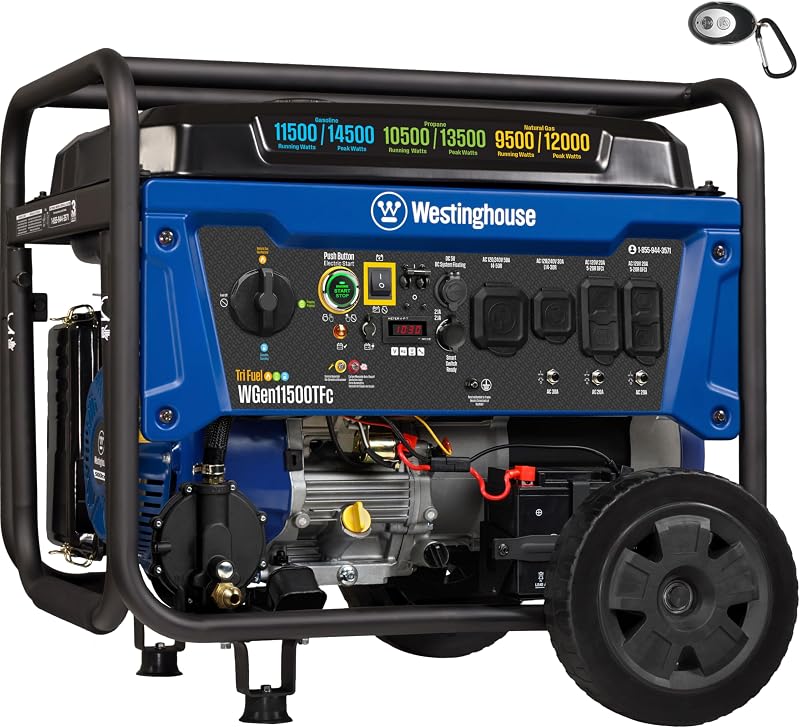
The Westinghouse 14500 Peak Watt Tri-Fuel Home backup generator, model westinghouse wgen11500tfc, brings high output to an open-frame platform. A 550cc 4-stroke OHV engine with a cast-iron sleeve and copper windings delivers 14,500 peak and 11,500 running watts on gasoline, 13,500 peak and 10,500 running watts on propane, and 12,000 peak and 9,500 running watts on natural gas. Its 9.5-gallon fuel tank runs up to 19 hours on gasoline and 7 hours on a 20-pound propane cylinder.
The unit produces clean electricity with less than 5 percent total harmonic distortion, keeping electronics safe while handling heavy loads. The panel features two power outlets with GFCI protection and transfer switch compatibility. Automatic voltage regulation, carbon monoxide detection, push-button electric start, remote start, a fuel gauge, and an hour meter complete the package.
This generator fits larger properties with high electrical demands, such as central air conditioners and electric water heaters. It cedes ground to the iGen line when quiet operation and sub-3 percent distortion are required, and yields to the 18000-watt model for maximum capacity.
Westinghouse 13500 Peak Watt Tri-Fuel Home

Best for: Versatile home backup with multiple outlet options
Pros
- Five protected outlet receptacles
- Long 19 hour run time
- Durable 500cc engine
Cons
- Substantial weight during transport
The Westinghouse 13500 Peak Watt Tri-Fuel Home generator, cataloged as the westinghouse wgen10500tfc, delivers dependable heavy-duty power. Built with a 500cc 4-stroke OHV engine with a cast-iron sleeve, it yields 13,500 peak and 10,500 running watts on gasoline, 12,500 peak and 9,500 running watts on propane, and 10,000 peak and 8,500 running watts on natural gas. Its 9.5-gallon tank allows up to 19 hours of continuous runtime.
Equipped with five rubber-covered power outlets, it provides two GFCI 120V 5-20R 20-amp duplex receptacles, one transfer-switch-ready 120V L14-30R 30-amp port, one 120/240V 14-50R 50-amp port, and USB ports. Convenience features include push-button electric start, remote key fob, automatic voltage regulation, digital hour meter, low-oil shutdown, and carbon monoxide monitoring.
This model serves homeowners needing solid 10,500-watt gasoline output and diverse outlet connectivity for interlock kits and cords. It gives way to the enclosed iGen series when noise suppression is essential, and to the 14500-watt model for additional headroom.
Westinghouse 12500 Peak Watt Tri-Fuel Home
Best for: Mid-sized homes seeking balanced 50 amp capacity
Pros
- 50A and 30A transfer ready
- Remote key fob start included
- Reliable 457cc OHV engine
Cons
- Shorter 12 hour maximum runtime
The Westinghouse 12500 Peak Watt Tri-Fuel Home generator, designated as the westinghouse wgen9500tfc, offers dependable open-frame performance. Driven by a 457cc 4-stroke OHV engine with a cast-iron sleeve, it outputs 12,500 peak and 9,500 running watts on gasoline, 11,200 peak and 8,500 running watts on propane, and 9,500 peak and 7,500 running watts on natural gas. Its 6.6-gallon fuel tank provides up to 12 hours of runtime.
The control console features eight total power outlets, including two GFCI 120V 5-20R duplex receptacles, one transfer-switch-ready 120V L14-30R twist lock, and one 120/240V 14-50R port. Safety and operating systems include electric start with remote key fob, automatic voltage regulation, a digital hour meter, low-oil protection, and carbon monoxide sensors.
This generator suits homes requiring a 50-amp transfer connection to manage essentials like well pumps and water heaters without oversized displacement. It yields to the 12000-watt iGen inverter for lower noise and under 3 percent THD, and to the WGen10500TFc for longer runtime.
Westinghouse 18000 Peak Watt Tri-Fuel Home
Best for: High demand properties needing maximum generator output
Pros
- Massive 14500 running watts on gasoline
- Heavy duty 713cc V Twin engine
- Large 10.57 gallon tank
Cons
- 74 dBA operational sound level
The Westinghouse 18000 Peak Watt Tri-Fuel Home generator, known as the westinghouse wgen14500tfc, is the highest-capacity machine in the manufacturer’s lineup. Powered by a 713cc 4-stroke OHV V-Twin engine with a cast-iron sleeve and copper windings, it generates 18,000 peak and 14,500 running watts on gasoline, 16,000 peak and 13,000 running watts on propane, and 14,400 peak and 11,600 running watts on natural gas. A 10.57-gallon tank runs up to 16 hours at 25 percent load.
Despite heavy output, it maintains under 5 percent total harmonic distortion for electronics safety. The VFT Data Center tracks voltage, frequency, and lifetime hours. Outlets total seven connections: one 14-50R 50-amp, one L14-30R 30-amp, one L5-30R 30-amp, two GFCI 5-20R duplexes, and two USB ports. Features include automatic idle control, remote start, carbon monoxide shutdown, and an operating sound level down to 74 dBA.
This flagship workhorse is built for large homes, estates, and demanding job sites with high starting loads. It represents the best westinghouse tri fuel generator for raw electrical capacity, stepping aside only when compact dimensions and whisper-quiet operation take priority.
Matching a Model to Your Setup
- Quiet suburban neighborhoods with smart electronics: The Westinghouse 8200 Peak Watt Tri-Fuel Portable delivers enclosed sound dampening at around 60 dBA and under 3% THD clean power.
- Full-home backup requiring clean power and central cooling: The Westinghouse 12000 Peak Watt Tri-Fuel Portable pairs 9,000 running watts on gasoline with a 50-amp transfer switch outlet and under 3% THD.
- Standard residential setups wanting balanced 50-amp capacity: The Westinghouse 12500 Peak Watt Tri-Fuel Home provides 9,500 running watts on gasoline and eight outlet connections.
- Homes needing extended overnight runtimes on a single tank: The Westinghouse 13500 Peak Watt Tri-Fuel Home delivers up to 19 hours of continuous power from its 9.5-gallon fuel tank.
- Demanding households running heavy continuous loads with low THD: The Westinghouse 14500 Peak Watt Tri-Fuel Home offers 11,500 running watts on gasoline and under 5% THD.
- High-acreage properties and large estates with multi-ton HVAC: The Westinghouse 18000 Peak Watt Tri-Fuel Home provides 14,500 running watts via a 713cc V-Twin engine.
Before You Buy
Before selecting a model, consider installation requirements and accessories not covered in the product listings. The listings confirm included essentials such as oil, funnels, remote key fobs, battery chargers, and propane connection kits, but they do not specify whether the supplied natural gas hoses include quick-disconnect fittings that satisfy your local municipal plumbing codes. Additionally, natural gas supply line diameter and utility meter capacity (measured in BTUs) must be sufficient to support heavy displacement engines like the 500cc, 550cc, and 713cc units under sustained electrical loads.
Furthermore, the product listings do not include manual transfer switches, interlock kits, or exterior power inlet boxes. These items must be purchased separately and installed by a licensed electrician to connect the generator safely to your home breaker panel. Decibel ratings under full 100 percent load are also not specified in the listing data for open-frame units. Reviewing these mechanical and electrical factors alongside alternatives like a champion power generator ensures your emergency backup setup is complete before severe weather arrives.
FAQ
What is the difference between Westinghouse iGen and WGen models?
The iGen series consists of fully enclosed inverter generators designed for low noise, high fuel efficiency, and clean power with total harmonic distortion at or below 3 percent. The WGen series features open-frame generators built for maximum output, utilizing automatic voltage regulation, larger engine displacements, and rugged frames with THD ratings under 5 percent on select models.
How does fuel selection affect Westinghouse generator wattage?
Fuel energy density directly impacts generator performance. Gasoline provides the highest starting and running watts across every model. Liquid propane delivers slightly lower wattage, while natural gas provides the lowest output of the three. Natural gas, however, provides continuous operation from a home utility line without manual refueling.
Are Westinghouse tri-fuel generators safe for sensitive electronics?
Yes. The iGen8200TFc and iGen12000TFc maintain total harmonic distortion at or below 3 percent, protecting laptops, mobile phones, and smart home appliances. The open-frame WGen11500TFc and WGen14500TFc are engineered with less than 5 percent THD, making them safe for modern household electronics.
Can these Westinghouse generators connect to a home electrical panel?
Yes, through a properly installed transfer switch or mechanical interlock kit. Each model includes a 120/240V 30-amp or 50-amp outlet engineered to feed an exterior power inlet box, preventing dangerous electrical backfeeding into the utility grid.
What built-in safety features do these Westinghouse generators provide?
All six models include an automated carbon monoxide sensor that shuts down the engine if hazardous gas levels are detected. They also incorporate automatic low-oil shutdown switches, overload protection, and GFCI-protected household outlets for operator safety.