Bambu Lab 3D Printer Lineup: Which Model Fits Your Workflow?
Selecting the ideal hardware configuration requires balancing print speed, chassis enclosure stability, motion precision, and automated filament feeding.

What this report covers
- Models assessed
- 6
- Buyer rating range
- 4.0 – 4.8 of 5
- Last updated
- 25 Sep 2026
Figures above are read from the product listings for the models named below. Ratings are the average left by Amazon buyers, not a score awarded here.
As Amazon Associates, we earn from qualifying purchases. This means we may receive a small commission at no extra cost to you if you click through and make a purchase.
Selecting the ideal hardware configuration requires balancing print speed, chassis enclosure stability, motion precision, and automated filament feeding. Professional creators and production teams frequently decide whether an open-frame platform provides sufficient utility or whether a fully enclosed build volume is essential for technical filaments. Navigating this ecosystem means evaluating distinct kinematic architectures, from lightweight desktop beds to enclosed core systems. Searching for a dependable bambo lab 3d printer configuration ultimately hinges on matching your specific output demands to prevent workflow bottlenecks and unneeded peripheral expenditures.
The manufacturer organizes its current equipment catalog into clear operational tiers, ranging from accessible desktop beds to enclosed chambers and high-capacity feeding modules. The core lineup begins with open-frame printers, expands into enclosed multi-material combo packages, and includes high-heat conditioning units alongside factory-matched filament spools. In this bambu lab printer comparison, we examine how each platform functions so you can determine which bambu lab 3d printer to buy for your workshop.
Criteria matrix What each model in this report is credited with
Rows are the criteria that come up in the pros and cons listed for this lineup. A check means the criterion is named in this report’s write-up of that model; a dash means it is not. Criteria that apply to every model, or to only one, are left out because they separate nothing.
| Criterion | Bambu Lab P1S Combo 4.6★ | Bambu Lab P2S Combo 4.0★ | Bambu Lab A1 3D 4.8★ | High-Performance 3D Printer by 4.3★ | Bambu Lab P2S 3D 4.8★ | Bambu Lab PLA 3D 4.3★ |
|---|---|---|---|---|---|---|
| Materials | Named | Named | Not named | Named | Named | Named |
| Quick-swap nozzles | Named | Named | Not named | Not named | Named | Not named |
| AI failure detection | Not named | Named | Not named | Not named | Named | Not named |
| PMSM servo extruder | Not named | Named | Not named | Not named | Named | Not named |
| Mm s speed | Named | Named | Not named | Not named | Not named | Not named |
| Support multi-color | Not named | Named | Not named | Not named | Named | Not named |
| Adaptive airflow | Not named | Named | Not named | Not named | Named | Not named |
| Filament drying | Not named | Named | Not named | Named | Not named | Not named |
| Criteria named | 3 / 8 | 8 / 8 | 0 / 8 | 2 / 8 | 6 / 8 | 1 / 8 |
Built from the wording of this report, not from a bench test. A dash is not a fault: it only means the write-up does not mention that point for that model. Star figures are the average rating left by Amazon buyers, read from the product listing.
Bambu Lab 3D Printers Lineup at a Glance
| Model Name | Enclosure and Build | Speed or Thermal Rating | Multi-Color Support | Filament Compatibility |
|---|---|---|---|---|
| Bambu Lab P1S Combo | Enclosed metal chassis | 500 mm/s, 20000 mm/s² acceleration | Up to 16 colors with AMS | PLA, PETG, ABS, ASA, TPU; capable of PA, PC |
| Bambu Lab P2S Combo | Enclosed 50 °C chamber | 600 mm/s, 65 °C AMS drying | Multi-color via AMS 2 Pro | Engineering polymers, standard filaments |
| Bambu Lab A1 3D Printer | Open-frame metal frame | 10,000 mm/s² acceleration | Supports AMS lite (not included) | Standard filaments, PLA, PETG, TPU |
| High-Performance 3D Printer by Bambu Lab | Airtight PC/PA housing | 85 °C electro-magnetic drying | Up to 24 colors handling | PC/PA, brittle or soft materials via bypass |
| Bambu Lab P2S 3D Printer | Enclosed 50 °C chamber | 600 mm/s, PMSM servo extruder | Single color (Combo required for multi-color) | Standard filaments, engineering-grade materials |
| Bambu Lab PLA 3D Printer Filament | 1 kg spool consumable | High-speed printing, 0.03 mm tolerance | AMS compatible with RFID | Polylactic acid (PLA) |
The Models in Detail
Bambu Lab P1S Combo

Best for: Engineers printing enclosed multi-color technical models
Pros
- 500 mm/s speed with 20000 mm/s² acceleration
- Fully enclosed metal chassis
- Up to 16 colors with included AMS
Cons
- Not recommended for fiber reinforced filaments
The Bambu Lab P1S Combo pairs a fully enclosed metal chassis with the manufacturer’s automated material system for multi-color 3D printing right out of the box. Constructed with a black metal frame measuring 18.72 by 23.01 by 18.72 inches and weighing 47.5 pounds, the printer sets up in 15 minutes. Its motion system achieves printing speeds up to 500 mm/s alongside an acceleration rate of 20000 mm/s², supported by automatic bed leveling that removes manual leveling adjustments.
Material compatibility is a significant advantage of the enclosed architecture. The listing states the printer is ideal for PLA, PETG, TPU, PVA, PET, ABS, and ASA, while also capable of extruding technical materials like PA and PC. However, carbon-fiber and glass-fiber reinforced polymers are not recommended. By connecting the included Bambu Lab AMS, creators can output up to 16 colors in a single setup, making the bambu lab p1s combo an exceptional production package for functional prototypes.
This hardware suits engineers, functional prototypers, and small studios that need to print draft-sensitive materials like ABS without investing in specialized industrial enclosures. It gives way to the P2S platform when users require active chamber temperature regulation, quick-swap nozzles, and built-in spool drying.
Bambu Lab P2S Combo
Best for: Fast single-material functional prototyping without multi-color
Pros
- 600 mm/s print speed with AI failure detection
- Adaptive airflow with 50 °C chamber
- Quick-swap nozzles and auto calibration
Cons
- Does not support multi-color without Combo package
Best for: Commercial workshops requiring high-speed heated drying
Pros
- 600 mm/s speed with PMSM servo extruder
- AMS 2 Pro with 65 °C filament drying
- 50 °C chamber with carbon filtration
Cons
- Base printer requires Combo for multi-color
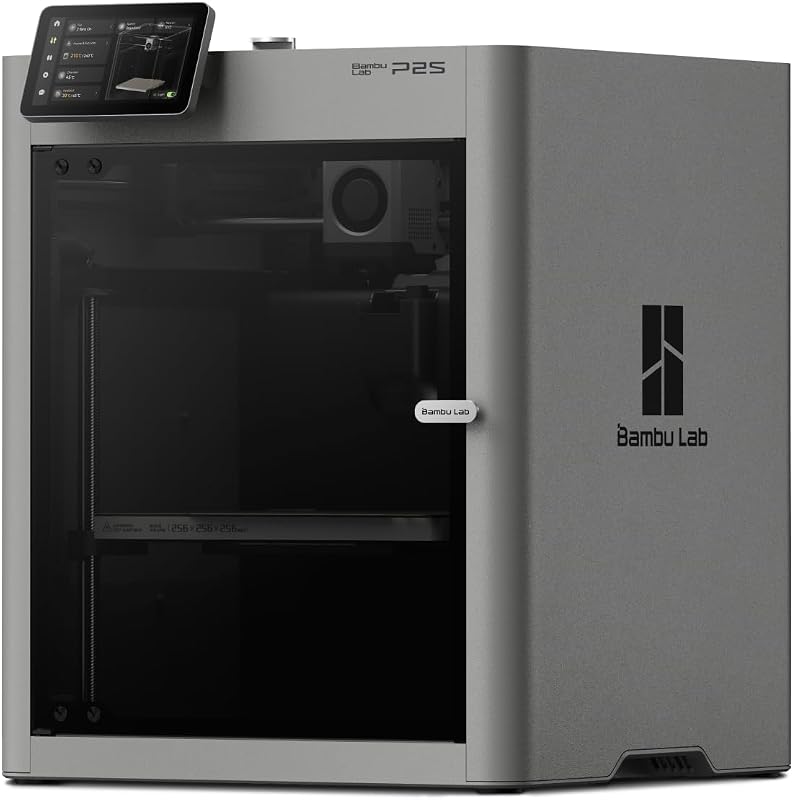
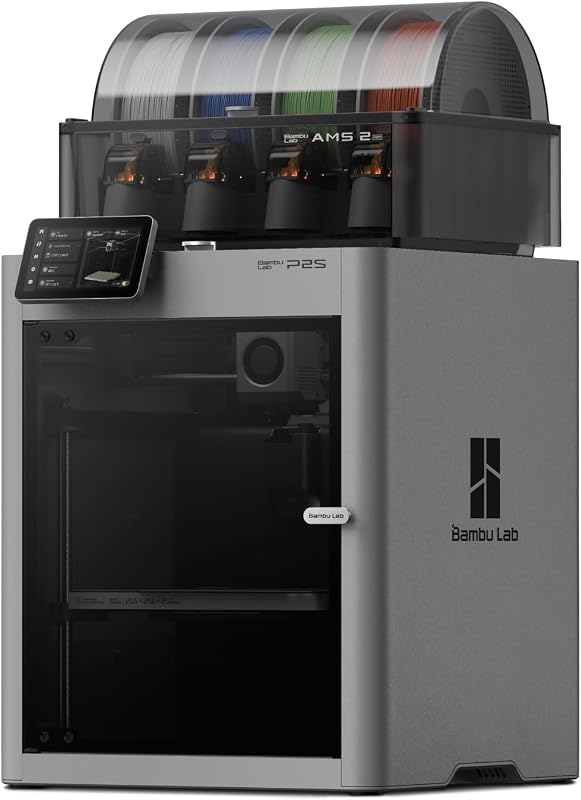
Engineered for high-demand professional environments, the Bambu Lab P2S Combo combines high-speed precision with active material conditioning. Measuring 18 by 22 by 18 inches and weighing 46.3 pounds, this grey unit prints at speeds up to 600 mm/s using a PMSM Servo Extruder and Active Flowrate Compensation. It is ready to print in 15 minutes and features quick-swap nozzles, automatic calibration, and AI failure detection for reliable unattended operation.
Chamber climate control is handled by an Adaptive Airflow System that maintains a 50 °C chamber for engineering-grade materials while filtering exhaust through a carbon filter. Multi-color and multi-material printing is powered by the included AMS 2 Pro, which features built-in filament drying at up to 65 °C. The listing highlights that the base printer requires this Combo version for multi-color production. Software integration covers Windows 10, Bambu Studio, Bambu Handy, and MakerWorld models.
This system suits commercial workshops and design departments that print technical filaments requiring strict thermal stability and dry spools. As a leading contender for the best bambu lab 3d printer title, the bambu lab p2s combo provides higher speed, higher drying capability, and smarter airflow than the P1S platform.
Bambu Lab A1 3D Printer

Best for: Designers and educators needing quiet desktop printing
Pros
- Full-auto calibration and active flow compensation
- 1-Clip quick swap nozzle design
- Quiet operation with simplified touchscreen
Cons
- Requires separate AMS lite for multi-color
The Bambu Lab A1 3D Printer is an open-frame desktop machine engineered for accessible, quiet, and high-speed operation. Built with hardened steel, stainless steel, and extruded aluminum, the 10-kilogram chassis measures 21.76 by 20.83 by 12.87 inches. The system achieves 10,000 mm/s² acceleration, controlled by active flow rate compensation algorithms that ensure consistent extrusion and smooth layer lines across all speeds.
User operation is simplified with full-auto calibration covering bed leveling and precise Z-offset adjustments. The toolhead features a 1-Clip quick swap nozzle system for effortless maintenance, accompanied by a simplified touchscreen display. The listing notes that multi-color printing requires an AMS lite module, which must be purchased separately or as part of the A1 Combo. This makes the standard bambu lab a1 3d printer a dedicated single-filament workhorse out of the box.
This model is ideal for educators, hobbyists, and office professionals prioritizing quiet operation and reliable printing with PLA, PETG, or TPU. It yields to the P1S and P2S models whenever prints require an enclosed environment to shield warp-sensitive engineering polymers from room drafts.
High-Performance 3D Printer by Bambu Lab
Best for: Specialists handling delicate filaments and high-heat drying
Pros
- 85 °C electro-magnetic active air vent drying
- Up to 24 colors multi-material handling
- Bypass outlet for soft or brittle materials
Cons
- Compact 1.21 kg material unit form factor
The High-Performance 3D Printer by Bambu Lab is described in the listing as the AMS HT high-capacity system, handling up to 24 colors and diverse engineering materials. Built from PC/PA materials with a net weight of 1.21 kilograms, the compact grey unit connects to laptops and personal computers, supporting standard STL and OBJ file formats. Feeding mechanics are driven by a brushless servo motor that delivers smooth filament delivery.
A standout capability of this hardware is its high-temperature filament drying system. Utilizing an electro-magnetic active air vent and a rotating mechanism, it dries spools at temperatures reaching 85 °C while providing airtight storage. An independent bypass material outlet accommodates soft or brittle filaments. The unit also includes RFID operation with automatic sync features to match official Bambu filament drying profiles without manual input.
This specialized bambu lab high performance 3d printer configuration is designed for engineering specialists and fabrication labs managing hygroscopic filaments that require elevated drying temperatures before extrusion. It delivers specialized material handling beyond standard desktop feeders, giving way to standard combo printers when basic multi-color handling is sufficient.
Bambu Lab P2S 3D Printer
For operations that want high-speed enclosed printing without multi-color feeder hardware, the Bambu Lab P2S 3D Printer provides a dedicated standalone solution. Built with an 18 by 21 by 18-inch grey chassis weighing 38.9 pounds, this machine delivers travel speeds up to 600 mm/s via its PMSM Servo Extruder and Active Flowrate Compensation. Like its combo sibling, it sets up in 15 minutes and incorporates quick-swap nozzles, AI failure detection, and automatic calibration.
Thermal regulation is maintained through an Adaptive Airflow System that holds an internal chamber temperature of 50 °C for engineering materials, alongside a carbon filter for clean air. The listing explicitly states that this standalone bambu lab p2s 3d printer does not support multi-color printing on its own, noting that the Combo version is required for multi-filament jobs. The machine connects seamlessly with Windows 10 computers and smartphones via Bambu Studio and Bambu Handy.
This standalone printer suits production cells, prototyping labs, and businesses needing fast single-material functional fabrication in an enclosed chamber. It gives users the complete mechanical performance of the P2S platform without paying for multi-spool feeding hardware, while preserving an upgrade path if multi-color capability is required later.
Bambu Lab PLA 3D Printer Filament
Best for: Makers wanting automated RFID filament configuration
Pros
- Integrated RFID automatic print settings sync
- High-speed printing without clogs or tangles
- Eco-friendly reusable spool hub
Cons
- Limited to PLA formulation
Consistent results require dependable raw materials, and the Bambu Lab PLA 3D Printer Filament is engineered to deliver reliable output across the brand’s high-speed machines. Supplied on a reusable spool containing 1 kilogram of tough black polylactic acid, this 1.75 mm filament maintains a strict manufacturing tolerance of +/- 0.03 mm. The listing notes that the material resists clogs, bubbles, and tangles during high-speed extrusion cycles.
Material management is streamlined by an integrated RFID tag that communicates directly with compatible feeding systems. When loaded into an AMS unit, the RFID chip instructs Bambu Studio to configure optimal printing temperatures, flow rates, and speeds automatically. The spool features an eco-friendly reusable design that minimizes waste, while providing broad compatibility with models from the MakerWorld library and official bambu lab accessories.
This consumable suits every owner of a Bambu Lab printer seeking trouble-free daily printing for visual concepts, decorative items, and general functional parts. For workshops running a bambu lab multi color 3d printer, pairing this RFID-enabled PLA with automated spool changers ensures rapid setup and consistent layer quality.
Matching a Model to Your Setup
- Demanding Multi-Color Engineering Prototypes: Choose the Bambu Lab P2S Combo for its 600 mm/s print speed, enclosed 50 °C chamber, carbon filtration, and the AMS 2 Pro with integrated 65 °C filament drying.
- High-Speed Single-Spool Production Runs: Select the Bambu Lab P2S 3D Printer if you need an enclosed chamber, PMSM servo extrusion, and AI failure detection without the added footprint of multi-color accessories.
- Enclosed Functional Printing on Standard Polymers: Pick the Bambu Lab P1S Combo to gain an enclosed metal chassis, 500 mm/s speed, and 16-color printing via the included AMS unit for ABS, ASA, and PLA.
- Quiet Desktop Prototyping and Light Modeling: Opt for the Bambu Lab A1 3D Printer for quiet classroom or office printing with full-auto calibration, active flow compensation, and quick-swap nozzles.
- High-Temperature Filament Preparation: Deploy the High-Performance 3D Printer by Bambu Lab when your workflow demands 85 °C active drying, rotating moisture extraction, and support for up to 24 colors.
- Reliable Everyday Material Stock: Stock the Bambu Lab PLA 3D Printer Filament to leverage automated RFID parameter detection, tight 0.03 mm tolerances, and tangle-free high-speed extrusion across your printer fleet.
Before You Buy
Before purchasing hardware from this lineup, verify the exact contents of the product package against your operational needs. A critical distinction across these listings is multi-color capability: while combo units include automated feeding systems, standalone units like the Bambu Lab P2S and Bambu Lab A1 explicitly require purchasing separate AMS or AMS lite modules to enable multi-filament output. Additionally, the listings do not specify the exact build volume dimensions in millimeters for several models, nor do they state whether extra replacement nozzles or maintenance tools are supplied in the shipping box.
Material compatibility restrictions also require careful review. The listing for the Bambu Lab P1S Combo explicitly notes that carbon-fiber and glass-fiber reinforced polymers are not recommended, meaning shoppers who need abrasive structural composites must inspect hardware wear ratings before printing. Furthermore, the listing for the High-Performance 3D Printer describes a lightweight 1.21-kilogram PC/PA unit with 85 °C drying and 24-color handling, but it does not specify whether it includes a gantry print mechanism or operates primarily as a multi-spool conditioning unit. Checking these specifications ensures your selection fits your workshop power and material demands.
FAQ
Which Bambu Lab 3D printer is best for technical filaments like ABS and ASA?
The Bambu Lab P2S Combo, Bambu Lab P2S 3D Printer, and Bambu Lab P1S Combo are best suited for technical filaments because they feature enclosed chambers that retain heat and block drafts. The P2S models maintain a 50 °C chamber and include an Adaptive Airflow System with a carbon filter, while the P1S features an enclosed metal body. The listing notes the P1S is not recommended for fiber-reinforced polymers.
Does the Bambu Lab P2S 3D printer support multi-color printing?
The standalone Bambu Lab P2S 3D printer does not support multi-color printing on its own. The product listing states that the Combo version, which bundles the AMS 2 Pro unit, is required to achieve multi-color and multi-material printing.
What drying temperatures do Bambu Lab material systems reach?
The AMS 2 Pro bundled with the Bambu Lab P2S Combo provides active filament drying at temperatures up to 65 °C. The High-Performance 3D Printer listing specifies a higher drying temperature of 85 °C using electro-magnetic active air vents and a rotating mechanism.
How fast does the Bambu Lab A1 3D printer accelerate?
The Bambu Lab A1 3D Printer listing specifies an acceleration rate of 10,000 mm/s². By comparison, the Bambu Lab P1S Combo listing specifies an acceleration rate of 20000 mm/s² and print speeds up to 500 mm/s, while the P2S models reach speeds up to 600 mm/s.
How does the RFID feature work on Bambu Lab PLA filament?
The Bambu Lab PLA 3D Printer Filament includes an integrated RFID chip. When loaded into an AMS unit, the RFID chip communicates with Bambu Studio software to configure optimal print settings automatically, eliminating the need to set temperatures and flow rates manually.


