The Top Filament Dryer Upgrades for Bambu Lab AMS Systems
When selecting a bambu labs filament dryer, professionals face a distinct choice between unified heated enclosures and modular multi-zone systems.

What this report covers
- Models assessed
- 4
- Our score range
- 8.6 – 9.4/10
- Last updated
- 25 Sep 2026
Figures above are read from the product listings for the models named below. Scores are out of 10, based on listed specifications and buyer feedback.
As Amazon Associates, we earn from qualifying purchases. This means we may receive a small commission at no extra cost to you if you click through and make a purchase.
When selecting a bambu labs filament dryer, professionals face a distinct choice between unified heated enclosures and modular multi-zone systems. The stock Bambu Lab Automatic Material System relies on passive desiccant packs, which fail to actively extract moisture once hygroscopic polymers absorb ambient humidity. Moisture trapped inside filament causes bubbling, severe stringing, and weakened interlayer bonding during extrusion. Integrating an active filament dryer for bambu lab setups solves these printing defects by elevating internal temperatures during operation. The primary challenge is finding an upgrade that delivers sufficient thermal energy without overheating the internal mechanical feed components, melting plastic spool rims, or complicating multi-spool automated loading.
The available product range is structured primarily as drop-in lid replacements designed for Bambu Lab AMS Gen 1 units. Manufacturers approach heating in two ways: shared-volume heating lids and compartmentalized independent chambers. Single-zone units like the sunlu ams heater gen 1 systems direct forced warm air throughout the entire upper casing, raising the temperature of all four spools simultaneously up to 70°C. In contrast, advanced systems such as the eibos tetras filament dryer split the casing into four separate thermal zones with dedicated venting. Understanding this bambu lab filament dryer comparison allows you to determine which bambu lab filament dryer to buy based on whether you run uniform print batches or mix disparate materials with conflicting drying temperatures.
Criteria matrix What each model in this report is credited with
Rows are the criteria that come up in the pros and cons listed for this lineup. A check means the criterion is named in this report’s write-up of that model; a dash means it is not. Criteria that apply to every model, or to only one, are left out because they separate nothing.
| Criterion | SUNLU AMS Heater 8.8/10 | SUNLU AMS Heater (2) 9.0/10 | SUNLU Filament Dryer 8.6/10 | 【EIBOS Official】 3D Printer 9.4/10 |
|---|---|---|---|---|
| PTC heating | Named | Named | Named | Not named |
| AMS Gen | Named | Named | Not named | Named |
| Circulation | Not named | Named | Named | Named |
| Humidity | Not named | Named | Named | Named |
| Thermal | Named | Named | Not named | Named |
| System | Not named | Named | Named | Named |
| Independent | Not named | Not named | Named | Named |
| Preheating | Named | Not named | Not named | Named |
| Criteria named | 4 / 8 | 6 / 8 | 5 / 8 | 7 / 8 |
Built from the wording of this report, not from a bench test. A dash is not a fault: it only means the write-up does not mention that point for that model. Scores next to each model are out of 10, based on listed specifications and buyer feedback.
Bambu Lab Filament Dryers Lineup at a Glance
| Model | Thermal Output | Chamber Design | Installation Method |
|---|---|---|---|
| SUNLU AMS Heater (SLMX-AH-US-GMSLUS) | Reaches 70°C in 20 minutes | Unified 4-spool volume | 3-step non-destructive lid replacement |
| SUNLU AMS Heater (DCUS-AH-US) | Reaches 70°C in 20 minutes | Unified 4-spool flat-top stackable | 3-step non-destructive drop-in swap |
| SUNLU Filament Dryer (AMS) | Reaches 70°C in 20 minutes | Unified 4-spool with auto-sensor | 2-minute tool-free cover swap |
| 【EIBOS Official】 3D Printer Filament Dryer | 20°C to 65°C range | 4 independent drying chambers | Drop-in add-on assembly |
The Models in Detail
SUNLU AMS Heater
Best for: Print farms running vertically stacked AMS arrays
Pros
- Flat top allows unit stacking
- Triple-safe PTC heating design
- Reaches 70°C in 20 minutes
- Isolates airflow from feeding motors
Cons
- Incompatible with AMS Gen 2
- Single shared heating chamber

Best for: Makers needing complete installation hardware included
Pros
- Reaches 70°C in 20 minutes
- Includes hinges screws and driver
- Non-destructive three-step installation
- Directs heat away from motors
Cons
- AMS Gen 1 only
- Unified single thermal zone
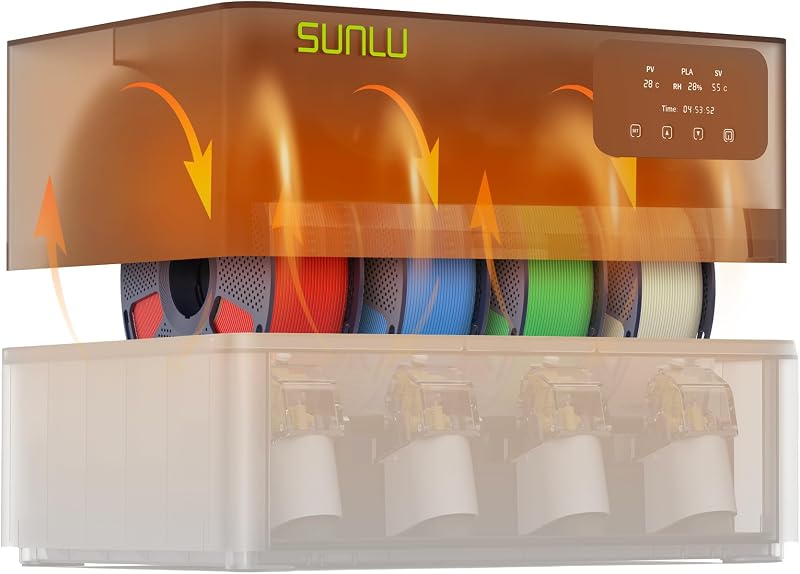
The SUNLU AMS Heater under part number SLMX-AH-US-GMSLUS is engineered specifically to convert the Bambu Lab AMS Gen 1 into an active drying environment. The listing highlights simultaneous printing and drying, allowing you to feed material through the automated multiplexer while maintaining elevated interior temperatures. Installation is non-destructive and replaces only the original AMS lid, preserving the primary electronics, drive rollers, and multi-color switching logic of the base system.
Thermal management is driven by an internal heating element capable of hitting 70°C (158°F) within 20 minutes. To protect sensitive hardware, the listing specifies a unique airflow design that directs heated air toward the filament spools while keeping high temperatures away from the bottom AMS feeding motors. Included in the package are the heater unit, a hexagonal screwdriver, eight hexagonal screws, four hinges, and a power cord. Operators reviewing our bambu labs spool guide will appreciate that this unified 4-spool ams filament dryer preserves standard 1.75 mm spool clearances across all four slots without requiring internal chassis trimming.
This model suits production workshops processing full sets of identical filaments like PETG, ABS, or PLA that require rapid preheating and continuous moisture defense. It delivers a fast 70°C thermal ramp with complete assembly hardware included. It yields to modular multi-zone units when operators need to run heat-sensitive materials alongside engineering filaments that demand distinct drying temperatures.
SUNLU AMS Heater
The SUNLU AMS Heater in black finish (part number DCUS-AH-US) offers a drop-in lid replacement for the AMS Gen 1 that focuses on spatial efficiency and enhanced thermal safety. Like its sister variant, this bambu lab ams dryer upgrade enables users to dry while printing, eliminating the downtime associated with pre-baking reels in standalone enclosures before loading. It replaces the stock top cover in three steps without drilling, cutting, or permanent modifications.
Safety and structural design form the core of this variant. The listing details a triple-safe heating system that combines a PTC heating element, a metal-roller circulation fan, a secondary thermal cutoff fuse, and smart software controls. Air duct channels isolate thermal circulation strictly to the filament zone, preventing motor fatigue. A critical structural feature emphasized in the listing is its flat top surface, which permits users to stack multiple AMS units or accessories vertically to conserve valuable bench space. Before setting drying schedules for standard materials, consult our bambu labs pla filament comparison to ensure optimal thermal thresholds.
This version is ideally matched for multi-printer print farms and tight studio workspaces where vertical stacking is necessary. It provides redundant electrical safeguards alongside rapid 20-minute heating to 70°C. It yields to automated sensor-driven lids when users require active relative humidity triggers rather than manual drying cycles.
SUNLU Filament Dryer

Best for: Users wanting automated humidity-triggered drying
Pros
- Humidity sensor auto-starts and stops
- Fast 20-minute heating to 70°C
- Two-minute tool-free installation
- Dual-airflow circulation system
Cons
- Shared single-zone temperature
- AMS chassis not included
The SUNLU Filament Dryer distributed under the Kunphy listing transforms the standard AMS into an automated moisture control station. This 4-roll capacity dryer features active drying during printing, allowing continuous moisture removal without pausing production runs. Fabricated from acrylonitrile butadiene styrene (ABS) and weighing 3.7 pounds, the unit forms a sealed drop-in replacement that seats directly onto the original AMS lower housing.
Automation is the defining characteristic of this model. It integrates an intelligent humidity sensor that monitors moisture levels within the enclosure, automatically starting the heating cycle when ambient moisture exceeds thresholds and shutting down once the target dryness level is attained. Heating is delivered via a PTC heating unit paired with a dual-airflow circulation layout that achieves 70°C within 20 minutes for materials like PLA, PETG, and ABS. When dialing in material settings, reviewing our bambu filament pla comparison helps identify the moisture thresholds where automatic intervention is most beneficial.
This automated lid is best for busy professionals who prefer a hands-off, automated environment where internal sensors regulate heating cycles without daily intervention. It eliminates the guesswork of manual timers. It yields to isolated multi-chamber systems when vastly different filaments must be maintained at independent temperatures in the same AMS.
【EIBOS Official】 3D Printer Filament Dryer

Best for: Advanced setups running mixed polymer types simultaneously
Pros
- Four independent drying chambers
- Motorized automatic exhaust vents
- Dedicated sensors and controls per slot
- Second-stage thermal preheating process
Cons
- Lower 65°C maximum temperature
- Heavier 8.8-pound total weight
The 【EIBOS Official】 3D Printer Filament Dryer, designated as the Tetras model, departs from shared-chamber designs by converting the AMS Gen 1 into a four-spool smart drying array with four completely independent drying chambers. Rather than heating the entire internal air volume uniformly, each of the four spool bays operates as an autonomous dryer equipped with its own dedicated heating element, circulation fan, control interface, temperature sensor, and humidity monitor.
Operational control is granular, supporting individual temperature adjustments between 20°C and 65°C and operational timers from 30 minutes up to 24 hours or continuous running. The Tetras incorporates an active drying process with intelligent moisture exhaust: internal fans circulate forced air across the heating element and over the spool, while an automated exhaust cover lifts to physically expel moisture-laden air from the enclosure. Once target levels are achieved, the chamber seals automatically to create an airtight storage box. A second-stage thermal profile provides stable preheating to ensure smooth extrusion for technical filaments like TPU and Nylon.
This system suits advanced technical prototyping environments running multi-material assemblies where delicate low-temp materials reside next to high-temp technical polymers. Each bay manages its own microclimate. It yields to standard unified SUNLU heaters if you need higher 70°C temperatures for bulk drying or prefer a lighter overall assembly than this 8.8-pound unit.
Matching a Model to Your Setup
- For vertically stacked multi-printer farms requiring compact footprints: Choose the SUNLU AMS Heater (DCUS-AH-US), which features a flat-top structural profile and triple-safe heating protections.
- For automated set-and-forget workflows: Choose the SUNLU Filament Dryer (AMS), which uses integrated humidity sensors to cycle the heater automatically without operator monitoring.
- For mixed-material printing with disparate thermal limits: Choose the 【EIBOS Official】 3D Printer Filament Dryer, which provides four completely independent thermal chambers ranging from 20°C to 65°C.
- For single-AMS workstations needing complete replacement hardware: Choose the SUNLU AMS Heater (SLMX-AH-US-GMSLUS), which ships with dedicated hinges, screws, and a driver for an immediate drop-in build.
- For technical polymers requiring active vapor venting: Choose the 【EIBOS Official】 3D Printer Filament Dryer to leverage motorized exhaust covers that physically expel humid air.
Before You Buy
All four products featured here are aftermarket heater upgrades and do not include the Bambu Lab AMS base unit itself. You must already own or purchase a Bambu Lab AMS Gen 1 chassis to use these lids. Furthermore, the listings explicitly state that these upgrades are incompatible with the Bambu Lab AMS 2nd generation. Power requirements are handled independently through dedicated external cords or power adapters, meaning these heating systems do not draw power from the 3D printer’s internal bus bar or AMS motherboard.
The listings do not specify maximum spool flange widths beyond compatibility with standard 1.75 mm spools engineered for the standard AMS cavity. If you utilize third-party cardboard spools or custom printed adapter rings, you must ensure they rotate freely within the original AMS roller spacing. Additionally, while the listings outline maximum drying temperatures between 65°C and 70°C, ambient room temperatures and operating decibel levels for the internal circulation fans are not specified in the manufacturer documentation.
FAQ
Can you print while these filament dryers are actively heating?
Yes. All four models are designed to maintain full spool feeding and rotation while the heating elements and circulation fans are active. The drop-in lids retain the internal geometry necessary for the Bambu Lab AMS Gen 1 feeder gears and multiplexer to swap filaments during active multi-color or single-color print jobs.
Are these dryer upgrades compatible with the Bambu Lab AMS 2nd generation?
No. The product listings state that these heaters are compatible exclusively with the Bambu Lab AMS Gen 1. They are not engineered to fit the dimensions, hinges, or latches of second-generation AMS hardware.
How do these heaters prevent the AMS drive motors from overheating?
The unified heaters from SUNLU utilize targeted ducting and airflow management that concentrates thermal circulation in the upper spool compartment, preventing hot air from collecting around the drive motors below. The EIBOS Tetras separates each spool bay into an isolated chamber to localize heat application away from shared mechanical drive components.
What is the difference between single-chamber and independent-chamber dryers?
Single-chamber heaters warm the entire interior of the AMS enclosure uniformly to one target temperature, making them ideal when all loaded spools share similar thermal tolerances. Independent-chamber dryers, like the EIBOS Tetras, isolate each spool bay with its own heater, sensor, and vent, allowing you to dry heat-sensitive filament alongside high-temperature material simultaneously.
Do these dryer upgrades require cutting or soldering to install?
No. Every model featured uses a non-destructive drop-in installation process. The upgrade is completed by removing the original factory AMS top cover and securing the heated replacement lid using the provided hinge points, without cutting plastic, drilling holes, or soldering wires.


