The Best TP-Link Tri-Band Routers: Ranked and Compared
Selecting the right tp link tri band router requires balancing wireless protocol generation, local network Ethernet capacity, and physical coverage layout.

What this report covers
- Models assessed
- 6
- Buyer rating range
- 4.0 – 4.9 of 5
- Last updated
- 25 Sep 2026
Figures above are read from the product listings for the models named below. Ratings are the average left by Amazon buyers, not a score awarded here.
As Amazon Associates, we earn from qualifying purchases. This means we may receive a small commission at no extra cost to you if you click through and make a purchase.
Selecting the right tp link tri band router requires balancing wireless protocol generation, local network Ethernet capacity, and physical coverage layout. Tri-band networking establishes three distinct radio frequencies—traditionally 2.4 GHz, 5 GHz, and the uncongested 6 GHz channel—to separate high-bandwidth clients from background smart home hardware. For busy professionals managing remote workstations, media streaming, and high-density environments, choosing between Wi-Fi 6E and Wi-Fi 7 hardware fundamentally dictates maximum wireless channel width, latency under multi-device load, and compatibility with multi-gigabit internet service tiers.
TP-Link organizes its tri-band offerings across two primary architectures: standalone Archer routers and decentralized Deco mesh systems. Within the Archer series, hardware progresses from entry-level Wi-Fi 6E units focused on reliable gigabit routing to specialized gaming platforms with targeted packet prioritization, culminating in flagship Wi-Fi 7 models equipped with multi-gigabit and 10 Gbps interfaces. The Deco line reconfigures this tri-band capacity into multi-node mesh arrays designed to blanket multi-floor structures. Understanding how port configurations, frequency allocations, and management interfaces diverge across these models simplifies determining which tp link tri band router to buy for your specific infrastructure.
Criteria matrix What each model in this report is credited with
Rows are the criteria that come up in the pros and cons listed for this lineup. A check means the criterion is named in this report’s write-up of that model; a dash means it is not. Criteria that apply to every model, or to only one, are left out because they separate nothing.
| Criterion | AXE5400 Tri-Band WiFi 6E 4.9★ | Tri-Band BE9300 WiFi 7 4.0★ | Deco XE75 AXE5400 Tri-Band 4.9★ | Tri-Band BE9700 WiFi 7 4.6★ | Tri-Band BE9700 WiFi 7 Router 4.6★ | Tri-Band AXE5400 Wi-Fi 6E 4.4★ |
|---|---|---|---|---|---|---|
| Hardware | Not named | Named | Named | Named | Named | Named |
| Wi-Fi | Not named | Named | Named | Named | Named | Named |
| Gbps LAN ports | Not named | Named | Not named | Named | Named | Named |
| GHz band | Not named | Named | Named | Not named | Named | Named |
| Dedicated 10 Gbps | Not named | Not named | Not named | Named | Named | Not named |
| Ethernet ports | Named | Not named | Named | Not named | Not named | Not named |
| GHz wireless | Named | Not named | Named | Not named | Not named | Not named |
| IoT network | Not named | Named | Not named | Named | Not named | Not named |
| Criteria named | 2 / 8 | 5 / 8 | 5 / 8 | 5 / 8 | 5 / 8 | 4 / 8 |
Built from the wording of this report, not from a bench test. A dash is not a fault: it only means the write-up does not mention that point for that model. Star figures are the average rating left by Amazon buyers, read from the product listing.
TP-Link Tri-Band Routers Lineup at a Glance
| Model | Wi-Fi Standard | Maximum Speed Rating | Ethernet Interface Array |
|---|---|---|---|
| Archer AXE75 | Wi-Fi 6E (802.11ax) | 5400 Mbps | 5x Gigabit Ports |
| Archer BE550 | Wi-Fi 7 (802.11be) | 9300 Mbps | 5x 2.5 Gbps Ports |
| Deco XE75 (3-Pack) | Wi-Fi 6E (802.11ax) | 5400 Mbps | 9x Gigabit Ports (3 per unit) |
| Archer BE600 | Wi-Fi 7 (802.11be) | 9700 Mbps | 1x 10 Gbps + 4x 2.5 Gbps Ports |
| Archer BE550 Pro | Wi-Fi 7 (802.11be) | 10000 Mbps | 1x 10 Gbps + 4x 2.5 Gbps Ports |
| Archer GXE75 | Wi-Fi 6E (802.11ax) | 5400 Mbps | 1x 2.5 Gbps + 5x Gigabit Ports |
The Models in Detail
TP-Link AXE5400 Tri-Band WiFi 6E Router

Best for: Standard gigabit internet homes
Pros
- Dedicated 6 GHz band
- Dual-core CPU with 512MB RAM
- OpenVPN and PPTP client support
Cons
- Gigabit-only Ethernet ports
- Fixed external antennas
The TP-Link AXE5400 Tri-Band WiFi 6E Router, known as the Archer AXE75, serves as the foundational tri-band platform in the lineup. It delivers cumulative wireless speeds up to 5400 Mbps distributed across three distinct bands: 2402 Mbps on 6 GHz, 2402 Mbps on 5 GHz, and 574 Mbps on 2.4 GHz. Operating on the 802.11ax standard, the 6 GHz frequency band opens uncontested spectrum for compatible devices, reducing interference from legacy wireless clients. Under the chassis, it integrates a 1.0 GHz dual-core processor backed by 512 MB of high-speed memory and a specialized vented housing structured for continuous thermal dissipation.
Physical connectivity includes five total Ethernet ports operating at standard gigabit rates. On the software side, the Archer AXE75 provides integrated VPN server and VPN client support out of the box, handling OpenVPN, PPTP, and L2TP protocols without requiring secondary firmware modifications. It incorporates TP-Link HomeShield basic network security, delivering automated IoT device identification, local network security scans, Quality of Service traffic rules, and basic parental controls. Mesh scalability is addressed via EasyMesh compliance, permitting network expansion with compatible extenders, routers, or powerline adapters.
This model is built specifically for users operating on traditional 1 Gbps broadband connections who require dedicated 6 GHz wireless channels for laptops and workstations without upgrading their entire wired infrastructure. It accommodates busy home offices seeking reliable concurrent transmission through OFDMA and beamforming. However, because its physical ports max out at 1 Gbps, it steps aside for the multi-gigabit Archer BE550 or BE600 when internet provisioning exceeds standard gigabit thresholds.
TP-Link Tri-Band BE9300 WiFi 7 Router

Best for: Multi-gigabit smart home networks
Pros
- Full 2.5G WAN and LAN ports
- 320 MHz channel Wi-Fi 7 speeds
- Dedicated private IoT network
Cons
- Lacks 10 Gbps Ethernet connectivity
Stepping into next-generation networking, the TP-Link Tri-Band BE9300 WiFi 7 Router brings the 802.11be standard into active deployment under the Archer BE550 designation. This unit reaches cumulative transfer rates of 9300 Mbps, allocating 5760 Mbps to the 6 GHz band, 2880 Mbps to the 5 GHz band, and 574 Mbps to the 2.4 GHz band. Wi-Fi 7 architectural enhancements include 320 MHz channel widths, 4K-QAM modulation, Multi-Resource Units (Multi-RUs), and Multi-Link Operation (MLO), which allows capable hardware to aggregate multiple wireless bands simultaneously into a unified data stream.
A primary mechanical advantage of the Archer BE550 is its all-2.5G port array, comprising one 2.5 Gbps WAN port and four 2.5 Gbps LAN ports, alongside a USB interface. Internal design utilizes six strategically positioned antennas managed by proprietary beamforming algorithms. For security isolation, the router offers a private IoT network protected by WPA3 encryption, running alongside HomeShield protections. Users configuring widespread coverage can review a tp link wifi booster or attach EasyMesh satellites to maintain uniform signal stability across remote areas.
The Archer BE550 suits tech professionals with multi-gigabit broadband subscriptions (such as 2 Gbps or 2.5 Gbps tiers) who maintain local network storage (NAS) units requiring multi-gigabit wired drops. It provides a balanced entry point into tp-link tri-band wifi 7 environments. It yields to higher-tier Archer platforms like the BE600 when an installation requires 10 Gbps Ethernet connectivity for high-capacity multi-gigabit modems.
TP-Link Deco XE75 AXE5400 Tri-Band WiFi

Best for: Large multi-floor residences
Pros
- Up to 7,200 sq ft coverage
- Dedicated 6 GHz wireless backhaul
- AI-driven seamless mesh roaming
Cons
- No multi-gigabit Ethernet ports
- Limited granular hardware controls
The TP-Link Deco XE75 AXE5400 Tri-Band WiFi three-pack shifts tri-band architecture into a decentralized mesh topology engineered to blanket structures up to 7,200 square feet. Total wireless capacity reaches 5400 Mbps across 6 GHz (2402 Mbps), 5 GHz (2402 Mbps), and 2.4 GHz (574 Mbps). By default, the system leverages the pristine 6 GHz frequency as a dedicated wireless backhaul to pass traffic between the three nodes without consuming user-facing 5 GHz airtime, though users can toggle the 6 GHz band into standard Wi-Fi network mode for direct Wi-Fi 6E client connections.
The system is verified under the CISA Secure-by-Design pledge and incorporates AI-driven mesh algorithms that continuously assess client connection metrics to optimize handoffs as devices roam. Across the three units, a total of nine Ethernet ports are available (three ports per node) for wired device backhaul or local peripheral integration. Network management runs through the Deco mobile application with integrated Alexa voice command support and the HomeShield security suite. Deployments requiring outdoor coverage extensions can also pair with specialized hardware like a deco outdoor wifi 7 satellite for complete property-wide roaming.
This mesh system is tailored for large single-family homes, multi-story properties, or wide commercial office layouts suffering from architectural dead zones. It prioritizes automated coverage uniformity and seamless roaming over granular port manipulation. Users looking for high-bandwidth local wired routing or dedicated 10G WAN interfaces will find standalone Archer alternatives more applicable.
TP-Link Tri-Band BE9700 WiFi 7 Router
Best for: Wired multi-device workstations
Pros
- Dedicated 10 Gbps WAN port
- Four 2.5 Gbps LAN ports
- High-bandwidth 320 MHz Wi-Fi 7
Cons
- Only one 10G port included
Best for: Ultra-fast multi-gigabit fiber connections
Pros
- 10 Gbps and 2.5 Gbps ports
- BE9700 Wi-Fi 7 with MLO
- Up to 2,600 sq ft coverage
Cons
- Coverage listing specifies 120 device limit
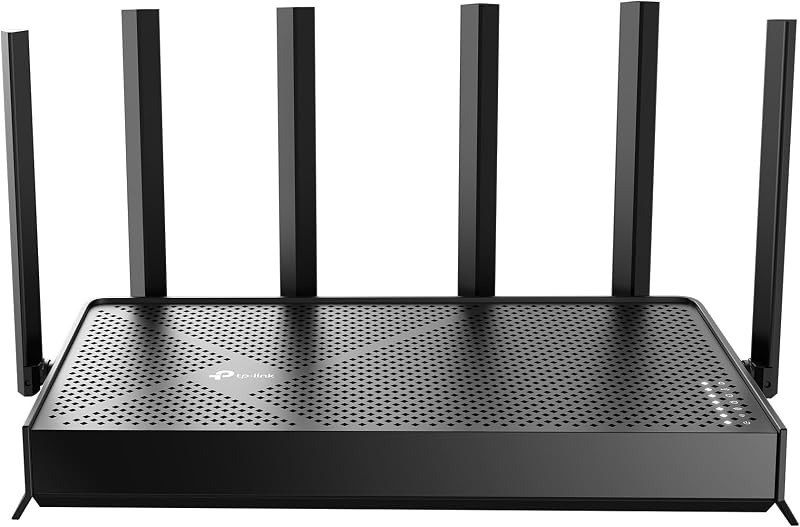
Targeting top-tier home networking throughput, the TP-Link Tri-Band BE9700 WiFi 7 Router (Archer BE600) delivers 9.7 Gbps of aggregate bandwidth across a 7-stream configuration. Band allocation delivers 5765 Mbps on 6 GHz, 2882 Mbps on 5 GHz, and 1032 Mbps on 2.4 GHz. Integrated Wi-Fi 7 features include 320 MHz channels, Multi-Link Operation (MLO), and 4K-QAM, delivering high-throughput connections to current flagship smartphones and workstation network cards. The hardware covers spaces up to 2,600 square feet and supports up to 120 devices simultaneously via six internal antennas.
The wired port layout provides extreme flexibility: one 10 Gbps WAN/LAN port, one 2.5 Gbps WAN/LAN port, and three dedicated 2.5 Gbps LAN ports, alongside a USB 3.0 storage port. This architecture permits a 10G fiber modem handoff while preserving multiple 2.5G ports for high-speed local clients. Security protocols include WPA3, CISA Secure-by-Design verification, HomeShield real-time IoT defense, and a dedicated IoT network for smart peripherals such as a tapo 2k pan/tilt security camera setup.
The Archer BE600 represents an optimal solution for creative professionals, video editors, and system administrators running heavy local backup workflows over 10 Gbps and 2.5 Gbps wired networks. It bridges expansive Wi-Fi 7 wireless capacity with enterprise-adjacent port speeds. It gives way to the Archer BE550 Pro when a strictly dedicated 10G WAN plus four independent 2.5G LAN configuration is desired.
TP-Link Tri-Band BE9700 WiFi 7 Router
The TP-Link Tri-Band BE9700 WiFi 7 Router (Archer BE550 Pro) refines high-speed network distribution with a dedicated 10 Gbps WAN interface coupled with an array of four 2.5 Gbps LAN ports and a USB 3.0 port. Achieving cumulative data transfer capabilities up to 10000 Mbps, it fully exploits 320 MHz channels on the 6 GHz band alongside 4K-QAM and Multi-Link Operation (MLO). The listing states that this Wi-Fi 7 architecture achieves up to four times lower latency than legacy Wi-Fi 6/6E routers.
Hardware housing conceals six optimally positioned internal antennas paired with beamforming to direct wireless energy into hard-to-reach areas. The router operates on a Linux-based operating system, managed via the Tether application or a comprehensive web interface, with additional support for Alexa and Google Assistant commands. Comprehensive security features encompass HomeShield network scanning, parental controls, WPA/WPA2-Enterprise (802.1x), and WPA3 encryption. EasyMesh compatibility ensures it can integrate with extra mesh nodes as coverage demands expand.
The Archer BE550 Pro is specifically built for prosumers with multi-gigabit fiber internet exceeding 2.5 Gbps who require a dedicated 10G WAN ingest pipe alongside four discrete 2.5 Gbps LAN drops for workstations, gaming consoles, and network switches. It yields to the Archer GXE75 if the primary operational focus is dedicated gaming QoS engines rather than 10G WAN throughput.
TP-Link Tri-Band AXE5400 Wi-Fi 6E Gaming
Best for: Competitive online gamers
Pros
- Hardware and game server acceleration
- Dedicated 2.5G multi-gigabit port
- Real-time game diagnostics dashboard
Cons
- LAN ports capped at 1 Gbps
- Wi-Fi 6E rather than Wi-Fi 7
The TP-Link Tri-Band AXE5400 Wi-Fi 6E Gaming router (Archer GXE75) focuses its tri-band resources directly on latency minimization and interactive application performance. It delivers 5.4 Gbps aggregate wireless speeds across three bands: 2402 Mbps on 6 GHz, 2402 Mbps on 5 GHz, and 574 Mbps on 2.4 GHz. Powered by a quad-core processor and housed in a game-centric chassis with customizable RGB elements, it uses the clear 6 GHz band to eliminate wireless interference during competitive gaming sessions.
Physical I/O includes one 2.5 Gbps RJ45 WAN/LAN port, one 1 Gbps WAN/LAN port, four 1 Gbps LAN ports, and a USB connection. Software features center around a dedicated Game Panel dashboard, providing real-time diagnostics on ping, jitter, router performance, and network battle environments. The router incorporates specialized acceleration engines for gaming applications, gear (headsets, mice, controllers), and game servers across platforms like Steam and Origin. Security is backed by HomeShield antivirus and CISA Secure-by-Design manufacturing standards.
This platform suits competitive online gamers, live streamers, and esports enthusiasts who prioritize traffic shaping, hardware acceleration, and 2.5G WAN modem connectivity. While highly capable for entertainment and interactive media, it yields to the Wi-Fi 7 Archer models (such as the BE550, BE600, or BE550 Pro) when wide 320 MHz channels and full multi-gigabit LAN backbones are required for enterprise productivity.
Matching a Model to Your Setup
- For large, multi-story residences needing uniform wireless coverage across 7,200 square feet without running Ethernet cables: TP-Link Deco XE75 AXE5400 Tri-Band WiFi.
- For multi-gigabit fiber subscriptions above 2.5 Gbps requiring a 10 Gbps wired WAN port alongside multi-gigabit LAN switching: TP-Link Tri-Band BE9700 WiFi 7 Router (Archer BE600 or Archer BE550 Pro).
- For balanced multi-gigabit local storage networks operating on 2.5 Gbps switches and NAS devices: TP-Link Tri-Band BE9300 WiFi 7 Router (Archer BE550).
- For competitive online gaming environments requiring packet prioritization, gear acceleration, and ping management: TP-Link Tri-Band AXE5400 Wi-Fi 6E Gaming (Archer GXE75).
- For standard 1 Gbps internet connections seeking a dependable, entry-level 6 GHz channel with VPN server flexibility: TP-Link AXE5400 Tri-Band WiFi 6E Router (Archer AXE75).
Before You Buy
Reviewing the technical details of these TP-Link listings reveals several critical setup requirements that are not bundled with the products. None of these routers contain internal modems; the listings state that a separate modem is required for service with major internet providers such as Comcast, Spectrum, AT&T, and Verizon. Additionally, while the multi-gigabit models feature 2.5 Gbps and 10 Gbps physical Ethernet ports, the listings do not specify the Ethernet cable category (such as Cat6 or Cat6a) included in the box, which is necessary to achieve full rated throughput over long cable runs.
Furthermore, physical coverage metrics vary significantly across the specifications. While the Deco XE75 system rates its three-pack coverage up to 7,200 square feet and the Archer BE600 specifies up to 2,600 square feet for 120 devices, the listings for the Archer AXE75, BE550, BE550 Pro, and GXE75 do not specify exact square footage numbers or maximum connected device ceilings. Finally, while all models feature free basic HomeShield tools, advanced cybersecurity defenses, automated reporting tiers, and extended parental filters require an optional subscription that is not outlined in detail on the retail listings.
FAQ
What is the primary difference in a tp link tri band comparison between Wi-Fi 6E and Wi-Fi 7?
A tp link tri band comparison between these wireless generations highlights major differences in channel width and protocol efficiency. While both tp-link tri-band wifi 6e and tp-link tri-band wifi 7 use the 6 GHz band to avoid legacy interference, Wi-Fi 7 expands maximum channel widths from 160 MHz up to 320 MHz. Wi-Fi 7 also introduces 4K-QAM modulation and Multi-Link Operation (MLO), which allows supported devices to transmit data across multiple frequency bands simultaneously for reduced latency and higher throughput.
Can the 6 GHz band on the Deco XE75 be accessed by personal devices?
Yes. By default, the Deco XE75 uses the 6 GHz wireless band as a dedicated backhaul channel to coordinate data transfers between the mesh nodes. However, through the Deco mobile application, users can reconfigure the 6 GHz band into standard Wi-Fi network mode, allowing Wi-Fi 6E-compatible smartphones, laptops, and workstations to connect directly to the 6 GHz radio.
Do these TP-Link tri-band routers support mesh network expansion?
Yes, all six models feature mesh expansion capabilities. The Deco XE75 operates within the proprietary TP-Link Deco mesh ecosystem, connecting seamlessly with other Deco units. The standalone Archer routers (AXE75, BE550, BE600, BE550 Pro, and GXE75) support EasyMesh technology, enabling users to add compatible extenders, routers, or wireless powerline adapters to build an interconnected whole-home network.
Which tp link tri band router to buy for internet plans over 1 Gbps?
For internet plans exceeding 1 Gbps, models equipped with multi-gigabit Ethernet interfaces are essential to avoid hardware bottlenecks. The Archer BE550 provides 2.5 Gbps WAN and LAN ports, while the Archer BE600 and Archer BE550 Pro feature 10 Gbps WAN connectivity alongside 2.5 Gbps ports. The Archer GXE75 also provides a single 2.5 Gbps WAN/LAN port. The Archer AXE75 and Deco XE75 are restricted to standard 1 Gbps Ethernet ports.
Are VPN services supported directly on these routers?
The Archer models, including the Archer AXE75 and Archer BE550, explicitly feature integrated VPN Client and VPN Server functionality. This allows network devices to route their traffic through remote OpenVPN, PPTP, or L2TP servers at the router level without installing individual software packages on every client device. The listings for the Deco XE75 do not specify client-level VPN features in the same manner.