TP-Link WiFi Booster Guide: Fast Recommendations for Reliable Home Office Coverage
Remote professionals encountering dropped video calls, delayed file synchronizations, or persistent dead zones in a home workspace face a clear hardware decision.

What this report covers
- Models assessed
- 6
- Our score range
- 8.2 – 9.6/10
- Last updated
- 25 Sep 2026
Figures above are read from the product listings for the models named below. Scores are out of 10, based on listed specifications and buyer feedback.
As Amazon Associates, we earn from qualifying purchases. This means we may receive a small commission at no extra cost to you if you click through and make a purchase.
Remote professionals encountering dropped video calls, delayed file synchronizations, or persistent dead zones in a home workspace face a clear hardware decision. Solving unreliable connectivity requires deciding between targeted plug-in range extenders and multi-unit whole-home mesh installations. Choosing an effective tp link wifi booster involves evaluating physical square footage, structural barriers, client device density, and wireless generations spanning Wi-Fi 5 (802.11ac), Wi-Fi 6 (802.11ax), and newer Wi-Fi 7 (802.11be) standards. Rather than reconfiguring an entire network, identifying the best tp link wifi booster allows you to direct reliable wireless signal directly to your primary office workstation.
TP-Link organizes its signal-expansion catalog into two distinct operational categories: standalone plug-in range extenders and multi-node mesh packages. The brand’s RE-series plug-in units link with your current router to rebroadcast coverage outward, utilizing OneMesh or EasyMesh protocols and adaptive path selection to maintain data flow. Meanwhile, systems like the Deco family establish a decentralized mesh architecture with unified network names, automated roaming, and built-in parental controls. Examining this tp link wifi booster comparison helps clarify bandwidth tiers—ranging from 733 Mbps to 3.2 Gbps—and physical port capabilities so you know exactly which tp link wifi booster to buy for your home office environment.
Criteria matrix What each model in this report is credited with
Rows are the criteria that come up in the pros and cons listed for this lineup. A check means the criterion is named in this report’s write-up of that model; a dash means it is not. Criteria that apply to every model, or to only one, are left out because they separate nothing.
| Criterion | AC1200 WiFi Extender Dual 8.6/10 | AX3000 WiFi 6 Dual-Band 9.6/10 | AC1900 WiFi Range Extender 8.2/10 | Deco S4 Mesh AC1900 8.6/10 | BE3200 Wi-Fi 7 Dual-Band 9.6/10 | WiFi Extender with Ethernet 8.6/10 |
|---|---|---|---|---|---|---|
| Deco mesh | Named | Named | Named | Named | Named | Not named |
| Router | Named | Named | Not named | Named | Named | Named |
| GHz band | Named | Named | Not named | Not named | Named | Not named |
| Adaptive Path Selection | Named | Not named | Not named | Not named | Not named | Named |
| Gigabit Ethernet port | Not named | Named | Named | Not named | Not named | Not named |
| Adjustable external | Named | Not named | Named | Not named | Not named | Not named |
| Combined bandwidth | Named | Not named | Not named | Not named | Named | Not named |
| Connected devices | Not named | Not named | Not named | Named | Not named | Named |
| Criteria named | 6 / 8 | 4 / 8 | 3 / 8 | 3 / 8 | 4 / 8 | 3 / 8 |
Built from the wording of this report, not from a bench test. A dash is not a fault: it only means the write-up does not mention that point for that model. Scores next to each model are out of 10, based on listed specifications and buyer feedback.
TP-Link WiFi Boosters Lineup at a Glance
| Model | Wireless Standard | Coverage Rating | Device Capacity | Ethernet Connectivity |
|---|---|---|---|---|
| TP-Link AC1200 WiFi Extender Dual Band (RE315) | Wi-Fi 5 (802.11ac) | Up to 1,500 sq. ft. | Up to 32 devices | 1 Fast Ethernet Port |
| TP-Link AX3000 WiFi 6 Dual-Band Range (RE715X) | Wi-Fi 6 (802.11ax) | Up to 2,400 sq. ft. | Up to 64 devices | 1 Gigabit Ethernet Port |
| TP-Link AC1900 WiFi Range Extender RE550 | Wi-Fi 5 (802.11ac) | Up to 2,100 sq. ft. | Up to 32 devices | 1 Gigabit Ethernet Port |
| TP-Link Deco S4 Mesh AC1900 WiFi | Wi-Fi 5 (802.11ac) | Up to 5,500 sq. ft. | Up to 100 devices | 6 Gigabit Ports (2 per unit) |
| TP-Link BE3200 Wi-Fi 7 Dual-Band Range (RE223BE) | Wi-Fi 7 (802.11be) | Up to 2,400 sq. ft. | Up to 64 devices | 1 Ethernet Port |
| TP-Link WiFi Extender with Ethernet Port (RE220) | Wi-Fi 5 (802.11ac) | Up to 1,200 sq. ft. | Up to 30 devices | 1 Ethernet Port |
The Models in Detail
TP-Link AC1200 WiFi Extender Dual Band

Best for: Apartment offices and modest dead zones
Pros
- EasyMesh compatibility
- Adaptive Path Selection
- Dual external antennas
Cons
- Fast Ethernet limited to 100 Mbps
- Incompatible with Deco mesh
The TP-Link AC1200 WiFi Extender Dual Band (model RE315) delivers a combined bandwidth rating of 1.2 Gbps, split between 867 Mbps on the 5 GHz band and 300 Mbps on the 2.4 GHz band. This dual-band unit employs two adjustable external antennas to eliminate dead zones across areas up to 1,500 square feet (with product overview text noting reach up to 1,600 square feet). Built-in Adaptive Path Selection automatically identifies the fastest backhaul connection to your router, while One-Touch Connection streamlines initial pairing. As a signatory of CISA’s Secure-by-Design pledge, TP-Link integrates verified security protocols directly into the hardware architecture.
For wired reliability, this tp link ac1200 wifi extender includes a single Fast Ethernet port, allowing you to hardwire a stationary office terminal, printer, or peripheral device such as an Amcrest outdoor WiFi camera mounted near an attached garage. The hardware also supports an alternate Access Point mode, converting a wired Ethernet drop into a fresh wireless hotspot. It connects up to 32 individual devices and integrates with EasyMesh-compatible routers for unified network management, though the listing specifies it is not compatible with Deco mesh systems.
This compact plug-in model suits remote professionals working from apartments, condominiums, or smaller single-floor spaces needing modest dead-zone relief. It provides stable everyday handling for web browsing, email routines, and audio calls. However, because its physical port is capped at Fast Ethernet speeds (100 Mbps) and wireless throughput tops out at AC1200, users running gigabit local file transfers or heavy multi-stream video editing will find greater utility stepping up to the AX3000 series.
TP-Link AX3000 WiFi 6 Dual-Band Range

Best for: Busy remote professionals streaming 4K video
Pros
- Fast Wi-Fi 6 throughput
- Dedicated Gigabit Ethernet port
- Beamforming directional antennas
Cons
- Large physical plug footprint
- Incompatible with Deco mesh
The TP-Link AX3000 WiFi 6 Dual-Band Range extender (model RE715X) upgrades transmission capabilities to modern Wi-Fi 6 standards. It outputs up to 3,000 Mbps of aggregate bandwidth, offering up to 2,404 Mbps on the 5 GHz band and 574 Mbps on the 2.4 GHz band. Designed for coverage up to 2,400 square feet, the hardware incorporates two high-gain directional antennas paired with Beamforming technology to focus transmission paths toward connected clients. It supports concurrent connections for up to 64 devices, managing network traffic with OFDMA technology to minimize transmission latency under heavy loads.
Hardware connectivity on this tp link ax3000 range extender features a dedicated Gigabit Ethernet port, ensuring an unthrottled wired pipeline for desktop workstations, network storage, or gaming consoles. Users can deploy this port in standard extender operation or toggle Access Point mode to broadcast Wi-Fi 6 signals from an existing wired router. The RE715X features Smart Adaptive Roaming and EasyMesh/OneMesh compatibility, allowing smooth handoffs when paired with compatible networking gear such as TP-Link tri-band routers, while excluding Deco mesh integration.
Professionals whose daily workflow demands continuous 4K video conferencing, large cloud data synchronization, and uninterrupted virtual desktop sessions will benefit most from this device. The listing notes that wireless extenders improve coverage rather than raw incoming line speeds, and real-world extender throughput typically measures 50 percent or less of base router performance. Where higher multi-room capacity across multiple stories is necessary without managing individual extender nodes, the multi-unit Deco S4 system represents the logical alternative.
TP-Link AC1900 WiFi Range Extender RE550
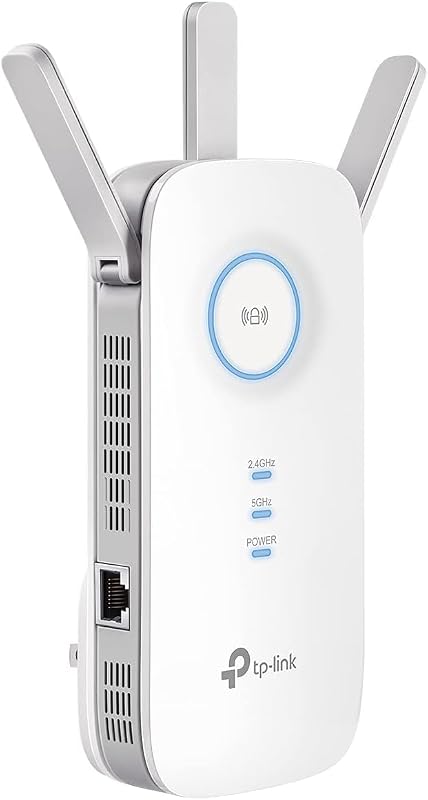
Best for: Multi-room coverage across larger single-story homes
Pros
- Three adjustable external antennas
- Gigabit wired connectivity
- Broad 2,100 square foot range
Cons
- Wi-Fi 5 protocol generation
- Incompatible with Deco mesh
The TP-Link AC1900 WiFi Range Extender RE550 is an expanded Wi-Fi 5 solution providing 1.9 Gbps of total bandwidth, configured as 1,300 Mbps on the 5 GHz frequency band and 600 Mbps on the 2.4 GHz band. Physical coverage is driven by three externally adjustable antennas, rated in the specification sheet for up to 2,100 square feet (and noted up to 2,800 square feet in the descriptive overview). It accommodates up to 32 concurrent client devices and supports CISA Secure-by-Design security standards to safeguard internal network communications.
A built-in Gigabit Ethernet port allows direct, high-speed wired access for office hardware that cannot afford wireless jitter. Like its companion extenders, this tp link ac1900 wifi range extender offers dual functional personalities: standard repeater mode and dedicated Access Point mode. Smart Adaptive Roaming ensures seamless transition between access nodes when combined with EasyMesh-compatible routers, though the manufacturer explicitly confirms it does not link with Deco mesh setups.
This model is built for homeowners with wide single-level floor plans or extended layouts where three adjustable antennas can be repositioned to push signal through challenging corridors. It serves households juggling simultaneous Zoom meetings and standard media streaming across several rooms. However, users seeking the advanced efficiency of Wi-Fi 6 or Wi-Fi 7 protocols should look toward the RE715X or RE223BE instead.
TP-Link Deco S4 Mesh AC1900 WiFi

Best for: Multi-floor homes needing unified mesh coverage
Pros
- Covers up to 5,500 square feet
- Six total Gigabit Ethernet ports
- Robust built-in parental controls
Cons
- Wi-Fi 5 speed tier
- Incompatible with EasyMesh RE extenders
The TP-Link Deco S4 Mesh AC1900 WiFi system departs from conventional wall-plug repeaters by deploying a coordinated three-unit mesh topology. Delivering 3×3 AC1900 speeds across a unified network, the 3-pack creates up to 5,500 square feet of continuous coverage designed to eliminate interior dead zones entirely. The system supports up to 100 connected devices, making it the highest-capacity solution in this roundup. Because it functions as a true mesh, your devices transition between nodes under a single network name and password without manual reconnection breaks.
Each individual Deco S4 tower contains two Gigabit Ethernet ports (providing six gigabit ports across the three-pack) with WAN/LAN auto-sensing, allowing any single unit to operate as the central Wi-Fi router connected to your broadband modem. The system supports wired Ethernet backhaul configurations, routing backhaul traffic through physical cables for maximum stability. System setup and management operate through the Deco mobile app, complemented by voice control via Alexa, and the platform incorporates robust parental controls to manage screen time and filter content by profile. If outdoor coverage is required later, Deco mesh systems can link with compatible hardware like a Deco outdoor WiFi 7 mesh unit.
The tp link deco s4 mesh is the ideal recommendation for large, multi-story residences where wall-plug extenders struggle to relay signals across vertical floors. It provides a complete replacement for weak ISP gateway wireless, keeping all household devices operating smoothly. It gives way to the RE-series extenders only when a user already owns a robust standalone router and simply requires a quick, single-room signal boost without replacing their primary routing setup.
TP-Link BE3200 Wi-Fi 7 Dual-Band Range
Best for: Modern setups leveraging low-latency Wi-Fi 7
Pros
- Wi-Fi 7 Multi-Link Operation
- Four beamforming antennas
- 2 Gbps combined bandwidth
Cons
- No 6 GHz band support
- Requires Wi-Fi 7 router for MLO
The TP-Link BE3200 Wi-Fi 7 Dual-Band Range extender (model RE223BE) introduces Wi-Fi 7 performance into a flexible plug-in form factor. Operating across four data streams, it provides up to 3.2 Gbps of aggregate throughput, divided into 2,594 Mbps on the 5 GHz band and 688 Mbps on the 2.4 GHz band. Four strategically positioned internal antennas equipped with Beamforming project coverage across footprints up to 2,400 square feet for up to 64 devices. When paired with an upstream Wi-Fi 7 router, it unlocks Multi-Link Operation (MLO), Multi-RUs, 160 MHz channel bandwidth, and 4K-QAM modulation.
Multi-Link Operation combines transmission bands simultaneously, lowering packet latency and boosting reliability for high-priority computing tasks. The tp link be3200 wifi 7 includes a dedicated Ethernet port for wired client bridging, Access Point mode, a Guest Mode network option, an informative LED signal indicator, and bidirectional MU-MIMO support. Note that this specific dual-band model does not support the 6 GHz wireless band; it concentrates its Wi-Fi 7 enhancements entirely on the 2.4 GHz and 5 GHz spectrums. It connects seamlessly to EasyMesh routers but will not join Deco mesh networks.
This unit is crafted for technology-forward professionals utilizing Wi-Fi 7 laptops, workstations, or handhelds who require ultra-low latency for cloud computing, AR/VR tasks, or massive data handling. If your primary router is an older Wi-Fi 5 or Wi-Fi 6 model without MLO capabilities, the advanced performance perks remain dormant, making the AX3000 RE715X a more balanced pairing for older router hardware.
TP-Link WiFi Extender with Ethernet Port
Best for: Compact spaces needing secondary coverage expansion
Pros
- Ultra-lightweight compact design
- Adaptive Path Selection backhaul
- OneMesh integration
Cons
- Modest 733 Mbps bandwidth
- Capped at 30 connected devices
The TP-Link WiFi Extender with Ethernet Port (model RE220) is a streamlined dual-band booster delivering up to 733 Mbps total bandwidth (433 Mbps on 5 GHz and 300 Mbps on 2.4 GHz). Engineered to cover up to 1,200 square feet, this ultra-compact unit links up to 30 client devices simultaneously. It delivers up to 44 percent more bandwidth than legacy single-band N300 extenders, making it an efficient tool for overcoming localized wireless dead zones.
Equipped with Adaptive Path Selection (APS), the RE220 dynamically selects the most efficient backhaul route between your router and endpoint devices. It features OneMesh compatibility, enabling unified network naming when paired with supported TP-Link routers. The unit incorporates an integrated Ethernet port (listed with USB 2.0 connector architecture in technical specifications) to provide a hardwired link for legacy office devices, desktop towers, or streaming media players. At just 3.2 ounces with an unobtrusive wall-plug profile, it integrates into any standard outlet without blocking adjacent plugs.
This tp link re220 wifi extender suits remote workers operating in small home offices, accessory dwelling units, or studio spaces needing fundamental signal extension for basic cloud productivity, word processing, and occasional video streaming. It gives way to the AC1200 RE315 and AX3000 RE715X when your workspace demands gigabit ethernet passthrough, broader device limits, or high-bandwidth 4K video feeds.
Matching a Model to Your Setup
- Multi-story homes and sprawling layouts up to 5,500 square feet: The TP-Link Deco S4 Mesh AC1900 WiFi provides whole-home roaming, three modular nodes, and six gigabit ports to eliminate dead zones without dropping calls between floors.
- High-demand modern home offices with Wi-Fi 6 laptops: The TP-Link AX3000 WiFi 6 Dual-Band Range (RE715X) provides 3 Gbps bandwidth, Beamforming, and a Gigabit Ethernet port for high-volume 4K video calls and rapid file sharing.
- Next-generation computing spaces requiring minimized latency: The TP-Link BE3200 Wi-Fi 7 Dual-Band Range (RE223BE) leverages Multi-Link Operation and 160 MHz channels to deliver stable, low-latency performance on dual bands.
- Large single-level residences up to 2,100 square feet using Wi-Fi 5: The TP-Link AC1900 WiFi Range Extender RE550 utilizes three adjustable external antennas and gigabit wired output to broadcast signal through difficult structural hallways.
- Standard apartments and secondary home workspaces: The TP-Link AC1200 WiFi Extender Dual Band (RE315) covers up to 1,500 square feet with dual external antennas and EasyMesh compatibility for steady daily productivity.
- Compact rooms and focused workstation bridging: The TP-Link WiFi Extender with Ethernet Port (RE220) offers an ultra-light 1,200 square-foot booster with Adaptive Path Selection for basic browsing and legacy device hookups.
Before You Buy
Before purchasing any wireless booster, understand the technical operational realities outlined across TP-Link’s product listings. Standalone wireless extenders are engineered specifically to broaden physical coverage footprints, not to directly increase the underlying speed delivered by your Internet Service Provider. In practice, data retransmitted across standard wireless repeater links typically operates at 50 percent or less of original router speeds due to half-duplex relay overhead. While improving signal stability and eliminating packet loss significantly enhances real-world application performance, extenders cannot surpass the raw line speed arriving at your primary gateway.
Additionally, pay close attention to hardware ecosystem compatibility. The product listings explicitly note that RE-series range extenders (such as the RE315, RE715X, RE550, and RE223BE) support OneMesh or EasyMesh router pairing, but they are not compatible with TP-Link’s Deco mesh family. Furthermore, the listings do not specify real-world signal attenuation metrics through specialized building materials such as brick, plaster, or metallic framing. Accessories such as patch cables or mounting brackets are not detailed as included in the extender packages, so plan your physical outlet placement and workstation cable runs accordingly.
FAQ
Does a TP-Link WiFi booster increase my overall internet speed?
No. TP-Link product documentation states that wireless extenders are designed to increase wireless coverage and eliminate dead zones, not to increase your incoming broadband internet speed. Connecting through a wireless extender typically yields speeds that are 50 percent or less of your router’s direct throughput due to transmission overhead. However, by replacing a faint, dropping signal with a stable connection, an extender often improves real-world browsing reliability and video conferencing quality.
Can I use a TP-Link RE-series extender with a TP-Link Deco mesh system?
No. The listings explicitly specify that TP-Link RE-series extenders (including the RE315, RE715X, RE550, and RE223BE) are not compatible with Deco mesh systems. Deco units operate exclusively within the proprietary Deco Mesh ecosystem, where all Deco models can interconnect, while the RE-series extenders rely on EasyMesh or OneMesh protocols to pair with standard standalone routers.
Does the TP-Link BE3200 Wi-Fi 7 extender support the 6 GHz frequency band?
No. The product listing explicitly clarifies that the TP-Link BE3200 (RE223BE) is a dual-band Wi-Fi 7 device that operates exclusively on the 2.4 GHz and 5 GHz frequency bands. It does not support the 6 GHz band. It still delivers Wi-Fi 7 benefits such as Multi-Link Operation (MLO) and 4K-QAM across its supported dual-band spectrum when paired with a compatible Wi-Fi 7 router.
What is the difference between Access Point mode and Extender mode?
In Extender mode, the device connects to your main router wirelessly and rebroadcasts that wireless signal outward to cover dead zones. In Access Point (AP) mode, the device connects to your router via a physical Ethernet cable plugged into its onboard port, transforming that hardwired feed into a fresh, dedicated wireless broadcast without wireless relay penalty.
How does Adaptive Path Selection benefit home office workflows?
Adaptive Path Selection (APS) dynamically evaluates the 2.4 GHz and 5 GHz backhaul connections between the extender and the primary router. By automatically routing data traffic through the fastest available frequency band, APS prevents congestion, maintains optimal throughput, and reduces latency spikes during critical remote work tasks like video meetings or VoIP phone calls.


