Ubiquiti Managed Switch Guide: Decisive Picks by Port Count and PoE
Selecting an enterprise-grade ubiquiti managed switch requires navigating practical hardware realities: spatial footprints, endpoint port counts, and the electrical power demands of connected devices.

What this report covers
- Models assessed
- 6
- Buyer rating range
- 4.4 – 4.9 of 5
- Last updated
- 25 Sep 2026
Figures above are read from the product listings for the models named below. Ratings are the average left by Amazon buyers, not a score awarded here.
As Amazon Associates, we earn from qualifying purchases. This means we may receive a small commission at no extra cost to you if you click through and make a purchase.
Selecting an enterprise-grade ubiquiti managed switch requires navigating practical hardware realities: spatial footprints, endpoint port counts, and the electrical power demands of connected devices. Network administrators and IT professionals frequently balance the convenience of compact desktop units against the sheer density of rack-mounted distribution chassis. Choosing the wrong configuration risks network bottlenecks, tangled patch panels, or power supply shortfalls that prevent access points and security cameras from operating. By systematically evaluating RJ45 port counts, SFP uplink options, PoE budgets, and enclosure materials, you can implement an infrastructure that scales efficiently and maintains reliable connectivity across your entire deployment.
The manufacturer segments its switching hardware across well-defined tiers based on port capacity and power delivery capabilities found within the retail specifications. At the utility tier, compact desktop switches offer five to eight ports with flexible powering options via USB-C or standard PoE, making them ideal for localized workgroup expansion. The mid-tier incorporates wall-mountable, sixteen-port units designed to balance PoE+ output with quiet thermal performance for small offices. At the enterprise tier, full-width twenty-four-port appliances deliver rack-ready chassis, dedicated SFP fiber uplinks, and non-blocking backplanes designed for high-density wired distribution or heavy multi-device PoE+ power delivery. Conducting a detailed ubiquiti managed switch comparison ensures your network investment aligns directly with your physical space and throughput requirements.
Criteria matrix What each model in this report is credited with
Rows are the criteria that come up in the pros and cons listed for this lineup. A check means the criterion is named in this report’s write-up of that model; a dash means it is not. Criteria that apply to every model, or to only one, are left out because they separate nothing.
| Criterion | Ubiquiti Compact 5-Port Gigabit 4.7★ | Ubiquiti | Ubiquiti Networks UniFi USW-24 4.9★ | Ubiquiti Networks US-8-60W UniFi 4.4★ | Ubiquiti Networks UniFi Switch 4.5★ | 8-Port PoE Network Switch 4.5★ |
|---|---|---|---|---|---|---|
| Power adapter | Not named | Named | Not named | Named | Not named | Named |
| Non-blocking throughput | Not named | Not named | Named | Not named | Named | Not named |
| Gbps non-blocking | Not named | Not named | Named | Named | Not named | Not named |
| Plastic chassis | Not named | Not named | Named | Not named | Named | Not named |
| Ethernet ports | Not named | Named | Not named | Named | Not named | Not named |
| PoE ports | Not named | Not named | Not named | Named | Not named | Named |
| PoE power | Named | Not named | Not named | Not named | Not named | Named |
| Gbps SFP | Not named | Not named | Named | Not named | Named | Not named |
| Criteria named | 1 / 8 | 2 / 8 | 4 / 8 | 4 / 8 | 3 / 8 | 3 / 8 |
Built from the wording of this report, not from a bench test. A dash is not a fault: it only means the write-up does not mention that point for that model. Star figures are the average rating left by Amazon buyers, read from the product listing.
Ubiquiti Network Switches Lineup at a Glance

Best for: Wall-mounted branch offices running PoE+ hardware
Pros
- Eight auto-sensing PoE+ ports
- Included wall mounting kit
- Durable metal casing
Cons
- External 60W power brick
- Total PoE capped at 45W
| Model | Port Configuration | PoE Capabilities | Form Factor and Chassis |
|---|---|---|---|
| Ubiquiti Compact 5-Port Gigabit Switch | 5 RJ45 Ports | Powered via PoE or USB-C Input | Plastic Desktop Enclosure |
| Ubiquiti (USW-Lite-16-PoE) | 16 RJ45 Ports (8 PoE+) | 45W Total PoE+ Budget | Metal Wall-Mountable Housing |
| Ubiquiti Networks UniFi USW-24 Switch | 24 RJ45 Ports, 2 SFP Slots | Non-PoE Data Switching | Metal 1U Rackmount Enclosure |
| Ubiquiti Networks US-8-60W UniFi 8-Port Gigabit | 8 RJ45 Ports (4 802.3af PoE) | Up to 15W per Port (60W Total Adapter) | Plastic Desktop Chassis |
| Ubiquiti Networks UniFi Switch PoE 24 | 24 RJ45 Ports, 2 SFP Slots | Auto-Sensing 802.3af/at PoE+ | Plastic Enclosure, Rack-Ready (Renewed) |
| 8-Port PoE Network Switch by Ubiquiti | 8 RJ45 Ports | 52W Total PoE Capacity (60W Adapter) | Polycarbonate Fanless Enclosure |
The Models in Detail
Ubiquiti Compact 5-Port Gigabit Switch
Best for: Edge desks requiring USB or PoE input power
Pros
- Dual PoE or USB-C input power
- VLAN and port mirroring management
- Compact energy-efficient footprint
Cons
- Plastic casing material
- Specification lists 7.44 Mbps data rate
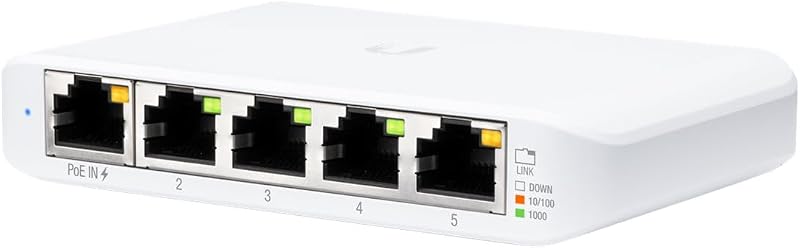
The Ubiquiti Compact 5-Port Gigabit Switch provides edge connectivity where standard electrical outlets are unavailable. According to its listing, this unit features five RJ45 ports and supports versatile powering via an upstream 802.3af/at PoE connection or a USB Type-C interface. Built into a plastic desktop chassis rated up to 40 degrees Celsius with a 30-watt maximum power threshold, it serves as a lightweight utility switch. While the title indicates gigabit capabilities, the specification table notes a data transfer rate of 7.44 megabits per second, pointing to its primary role in auxiliary network segmentation rather than high-throughput switching.
Managed via centralized configuration management tools, this ubiquiti compact 5-port switch supports configuration cloning, automated Auto-MDIX cable detection, and individual per-port operation modes for switching or port mirroring. Administrators can establish VLAN parameters, enable jumbo frames, enforce storm control settings, and monitor live transmission rates. This model suits workstations, laboratory benches, and retail registers needing isolated local network drops without adding extra power strips, though it does not provide PoE power output to connected client devices.
Ubiquiti
Referred to in listing details as the USW-Lite-16-PoE, the Ubiquiti model bridges compact desktop gear and full rackmount enclosures. The listing details sixteen Gigabit Ethernet ports, combining eight auto-sensing 802.3at PoE+ ports with six standard RJ45 connections to supply an aggregate 45-watt PoE budget. Encased in a metal chassis measuring 7.87 by 5.91 by 5.91 inches, the unit includes a wall-mount kit and utilizes an external 60-watt power adapter operating at 28 volts, maintaining a 1000 megabits per second data transfer rate.
Configured through the UniFi network controller and mobile app, the switch delivers Layer 2 protocols, port status telemetry, and centralized provisioning for connected smartphones, computers, and cameras. Integrating this ubiquiti 16 port poe switch gives branch offices, retail shops, and medical clinics a structured wall-mounted footprint without midspan power injectors. It comfortably powers several ceiling access points and VoIP phones, though administrators must keep total load within the 45-watt PoE limit to prevent overloading.
Ubiquiti Networks UniFi USW-24 Switch
Best for: High-capacity PoE rack expansions needing optical uplinks
Pros
- 24 auto-sensing PoE+ gigabit ports
- Two 1 Gbps SFP uplink slots
- 26 Gbps non-blocking throughput
Cons
- Supplied as renewed condition
- Specification lists plastic chassis

Best for: High-density rack cabinets without PoE requirements
Pros
- 24 Gigabit RJ45 Ethernet ports
- Two dedicated 1G SFP slots
- Rack mountable metal enclosure
Cons
- No PoE output capability
- Requires 220V power input specification
When deployments demand high wired port density without the thermal footprint or power draw of integrated PoE supplies, the Ubiquiti Networks UniFi USW-24 Switch delivers a dedicated solution. The USW-24 provides twenty-four Gigabit Ethernet RJ45 ports alongside two 1 Gbps SFP slots for fiber-optic switch uplinks. Built into a 1U rack-mountable black metal chassis weighing 3 kilograms, the unit operates on a 220-volt architecture with an ambient thermal limit of 40 degrees Celsius.
Running on a Linux management platform, this managed Layer 2 appliance supports an internal switching fabric with a data transfer rate of 24000 megabits per second (24 Gbps). This non-blocking architecture allows simultaneous wire-speed data transmission across all twenty-four access ports without packet drops. Deploying this ubiquiti unifi switch is ideal for corporate server racks, computer labs, and departmental wiring closets where client towers, storage arrays, and network printers already have dedicated AC power cords. Because it provides no PoE output, power-sourcing needs require external injectors or an alternative switch model.
Ubiquiti Networks US-8-60W UniFi 8-Port Gigabit

Best for: Desktop deployments powering four access points
Pros
- Four auto-sensing 802.3af PoE ports
- 8 Gbps non-blocking line rate
- Includes 60W power adapter
Cons
- 15W maximum per PoE port
- Plastic enclosure housing
The Ubiquiti Networks US-8-60W UniFi 8-Port Gigabit switch brings managed networking and power-over-Ethernet capabilities to compact team workspaces. The listing highlights eight Gigabit Ethernet ports, including four auto-sensing IEEE 802.3af PoE ports delivering up to 15 watts of output per port. Housed in a silver plastic enclosure weighing 15.2 ounces, the unit includes an external 60-watt AC/DC power adapter operating at 48 volts, rated for environments up to 40 degrees Celsius.
Featuring an 8 Gbps total non-blocking line rate and a 16 gigabits per second data transfer rate, the switch delivers enterprise performance through the centralized UniFi application. Network managers deciding which ubiquiti managed switch to buy can easily define VLANs, monitor live traffic, and power-cycle connected hardware remotely. This ubiquiti 8-port gigabit switch is tailored for conference tables, reception desks, and executive suites powering two or three access points and VoIP phones alongside local wired PCs, though higher-draw 802.3at PoE+ hardware will require a larger power budget.
Ubiquiti Networks UniFi Switch PoE 24
For high-capacity network environments requiring extensive port counts and high-wattage power budgets, the Ubiquiti Networks UniFi Switch PoE 24 (US-24-250W) provides substantial rack distribution. Offered as an Amazon Renewed unit, the listing highlights twenty-four Gigabit Ethernet RJ45 ports equipped with auto-sensing IEEE 802.3af/at PoE+, supported by two 1 Gbps SFP ports for fiber uplinks. It provides a total non-blocking throughput of 26 Gbps and a matched 26 gigabits per second transfer rate for simultaneous line-rate processing without packet loss.
The switch description details an extensive suite of Layer 2 switching protocols alongside Layer 3 routing capabilities, enabling direct inter-VLAN routing on the hardware. Administrators can assign custom port names and oversee high-output ubiquiti networks poe distribution from the central controller. This model suits multi-camera security arrays, corporate floors, and school facilities running numerous wireless access points, IP phones, and network printers. Shoppers should note its renewed status, white plastic chassis listing, and verify mounting accessories upon receipt.
8-Port PoE Network Switch by Ubiquiti
Best for: Noise-sensitive workspaces requiring eight PoE ports
Pros
- Silent fanless cooling architecture
- 52W total PoE power capacity
- Durable polycarbonate casing
Cons
- Requires external power adapter
- No dedicated SFP fiber cages
The 8-Port PoE Network Switch by Ubiquiti addresses noise-sensitive workspaces through a fanless, silent passive cooling design. Operating as an eight-port Layer 2 PoE switch, it features a durable polycarbonate enclosure measuring 6.44 by 3.92 by 1.25 inches and weighing 10.4 ounces. Its thermal engineering supports an operational temperature range from 5 degrees Fahrenheit up to 104 degrees Fahrenheit, ensuring stability across diverse indoor conditions.
An external 60-watt power adapter provides 52 watts of total PoE power capacity across its RJ45 interfaces, delivering ample headroom for PCs, printers, and surveillance hardware. By eliminating mechanical fans, this ubiquiti poe switch avoids motor noise, bearing degradation, and internal dust buildup over years of continuous operation. It serves open-plan offices, healthcare clinics, and audio recording studios requiring silent operation and higher PoE capacity, though linking to upstream networks requires using one of its eight RJ45 ports due to the absence of SFP slots.
Matching a Model to Your Setup
- Wall-Mounted Utility Closets: Choose the Ubiquiti (USW-Lite-16-PoE) for sixteen total ports, eight PoE+ delivery interfaces, and an included wall-mount bracket that saves critical floor space.
- High-Density Non-PoE Server Racks: Select the Ubiquiti Networks UniFi USW-24 Switch to aggregate twenty-four desktop PCs and printers across a 1U rack-mount chassis with dual SFP optical uplink cages.
- Facility-Wide PoE+ Infrastructure: Deploy the Ubiquiti Networks UniFi Switch PoE 24 when managing twenty-four powered endpoints, requiring a 26 Gbps non-blocking backplane and Layer 3 routing capabilities.
- Compact Desktops with Essential PoE: Pick the Ubiquiti Networks US-8-60W UniFi 8-Port Gigabit switch to power up to four 802.3af access points and VoIP phones directly from a compact desktop unit.
- Silent and Noise-Sensitive Workspaces: Install the 8-Port PoE Network Switch by Ubiquiti to take advantage of a 52W PoE capacity backed by completely fanless, passive cooling.
- Auxiliary Edge Isolation: Utilize the Ubiquiti Compact 5-Port Gigabit Switch to isolate local equipment using upstream PoE or USB-C power without an AC outlet.
Before You Buy
Before purchasing hardware from this lineup, take note of several important hardware boundaries that the listings do not specify or include in the packaging. Dedicated fiber transceivers and optical patch cords are not included with the twenty-four-port switches; administrators deploying SFP links must purchase compatible SFP modules separately based on their fiber infrastructure. Furthermore, while Layer 2 features are highlighted across these models, the listings do not specify routing table depth, internal packet buffer capacities, or maximum switching MTU boundaries beyond general references to jumbo frame support on entry-level models.
Mounting options and casing materials also demand careful scrutiny prior to installation. While the USW-Lite-16-PoE includes a dedicated wall-mounting kit and the USW-24 includes rack hardware, the compact 5-port and 8-port desktop models do not specify rack-ear brackets or DIN-rail compatibility. Additionally, multiple listings specify plastic or polycarbonate chassis, which behave differently regarding ambient heat dissipation compared to heavy metal enclosures. Always confirm whether your planned endpoints require standard 15W 802.3af power or higher-wattage 802.3at PoE+ power to ensure compatibility with your chosen switch.
FAQ
What is the difference between Layer 2 and Layer 3 switches in this lineup?
Layer 2 switches forward network traffic based strictly on hardware MAC addresses within the same local broadcast domain, managing VLAN tagging, port isolation, and port mirroring. Layer 3 switches provide internal routing intelligence, enabling them to route packets directly between different VLAN subnets without sending traffic up to an external router. In this roundup, models such as the USW-24 and USW-Lite-16-PoE operate at Layer 2, whereas the US-24-250W listing specifies both advanced Layer 2 switching protocols and Layer 3 routing capabilities.
Can the compact 5-port switch provide power to other network hardware?
No, the listing for the Ubiquiti Compact 5-Port Gigabit Switch explicitly indicates that it is a power-receiving device, drawing its operational energy from an upstream 802.3af/at PoE connection or via a USB Type-C adapter. The switch does not feature PoE passthrough or power-sourcing capabilities, meaning it cannot provide electrical power to downstream access points or IP phones.
How do the SFP ports operate on the 24-port switches?
The SFP ports on the USW-24 and the US-24-250W operate as dedicated 1 Gbps uplink slots designed for optical transceivers or direct-attach copper cables. These interfaces allow administrators to bridge switches across building floors or link back to core aggregation routers using fiber-optic cabling without consuming any of the twenty-four primary RJ45 copper Ethernet ports.
Are external power adapters included with the compact switches?
The listings confirm that the USW-Lite-16-PoE, the US-8-60W, and the 8-Port PoE Network Switch all include external 60-watt power adapters in their packaging. Conversely, the listing for the compact 5-port switch specifies support for USB-C or PoE input power but does not specify an included wall adapter, meaning administrators must supply an existing PoE network drop or standard USB-C charger.